Commentary
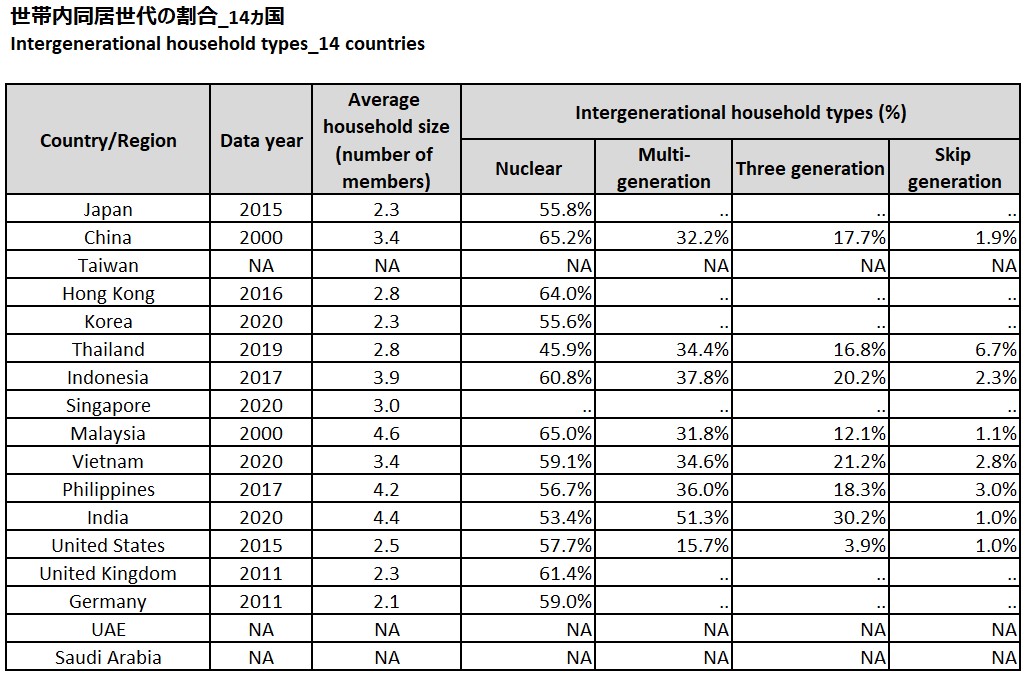
In all countries, nuclear families account for about 50-60% of the population. Of these, China has the highest percentage at 65.2% (2000) and Thailand has the lowest at 45.9% (2019).
India has the highest percentage of families with two or more generations living together at 51.3% (2020), while the United States has the lowest at 15.7% (2015).
Families with three or more generations living together are also highest in India at 30.2% (2020) and lowest in the United States at 3.9% (2015).
Segregated households are less than 7% in all countries. Of these, Thailand has the highest at 6.7% (2019) and India and the United States have the lowest at 1.0% (2020 and 2015).
―――
Generation Z, which accounts for about a quarter of the world’s population, is garnering attention as the largest consumer demographic of the future.
In this article, we use Intage’s consumer database “Global Viewer*” to compare Generation Z across 10 Asian countries and explain their commonalities and differences.
Understanding Generation Z Around the World: Country-Specific Trends Through Values and Daily Life
・Generation Z’s Values (Health, Parenting, Shopping, etc.)
・Generation Z’s Lifestyle
*Global Viewer
This service provides reports tailored to your issues using questionnaire data on various actual conditions and attitudes of sei-katsu-sha in 11 countries (Asia and US) stocked by INTAGE.
The service covers 400 items, including actual behavioral conditions and awareness, values, and information contact related to various product and service categories.
▼Click here for details
https://www.global-market-surfer.com/lp/gv/
Reference
United Nations, Population Division. ”Database on Household Size and Composition 2022”.
Retrieved April 10, 2023, from https://bit.ly/3cYepch
※Intergenerational household types are defined as follows
Nuclear: Sum of the percentages of couple only households, couple with children households, and single parent with children households.
Multi-generation: Percentage of households that include two or more generations of related members aged 20 years or over.
Three generation: Percentage of households that include three or more generations of related members, irrespective of age.
Skip generation: Percentage of households that consist of grandparents and their grandchildren, but none of the parents of the grandchildren.
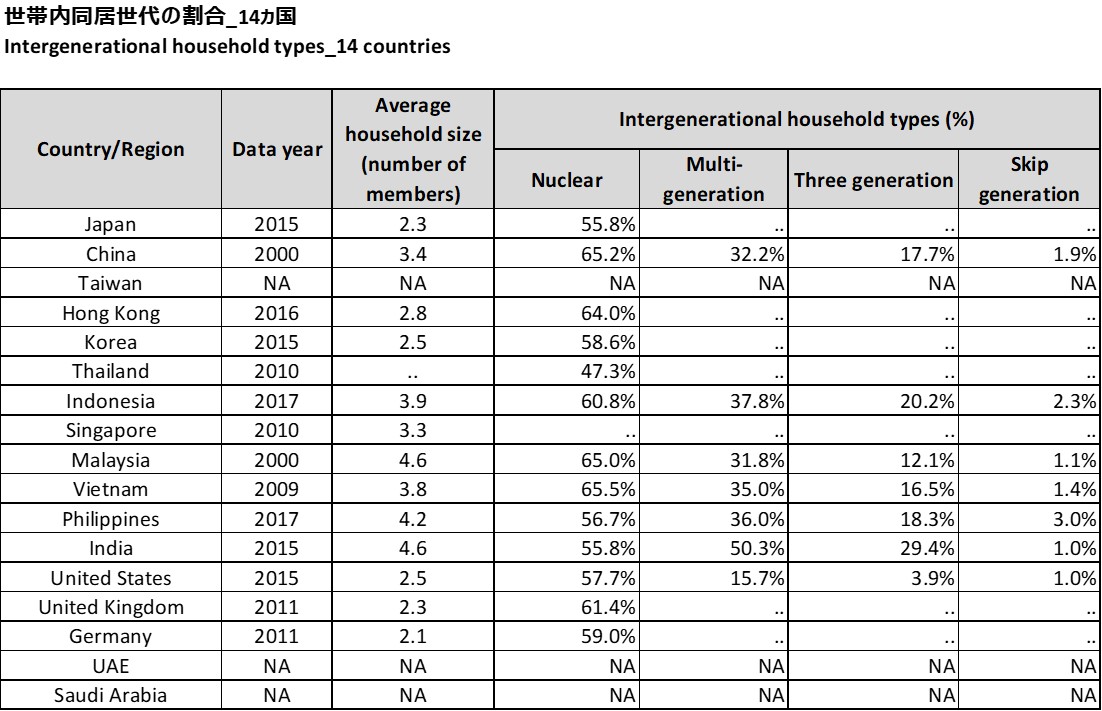
Commentary
いずれの国でも核家族は約5~6割程度を占める。そのうちベトナムが65.5%(2000年)で最も割合が多く、タイが47.3%(2010年)で最も少ない。 2世代以上同居の家族は、インドが50.3%(2015年)で最も高く、アメリカは15.7%(2015年)で最も低い。 3世代以上同居の家族も、インドが29.4%(2015年)で最も高く、アメリカは3.9%(2015年)で最も低い。 隔世世帯は、いずれの国でも5%未満。そのうちフィリピンが3.0%(2017年)で最も高く、インドとアメリカは1.0%(2015年)で最も低い。
Reference
Reference United Nations, Population Division. ”Database on Household Size and Composition 2019”. Retrieved Jun 18, 2021, from https://bit.ly/3cYepch ※Intergenerational household types are defined as follows Nuclear: Sum of the percentages of couple only households, couple with children households, and single parent with children households. Multi-generation: Percentage of households that include two or more generations of related members aged 20 years or over. Three generation: Percentage of households that include three or more generations of related members, irrespective of age. Skip generation: Percentage of households that consist of grandparents and their grandchildren, but none of the parents of the grandchildren.