Search Results
Infrastructure/Education - 3 results
-
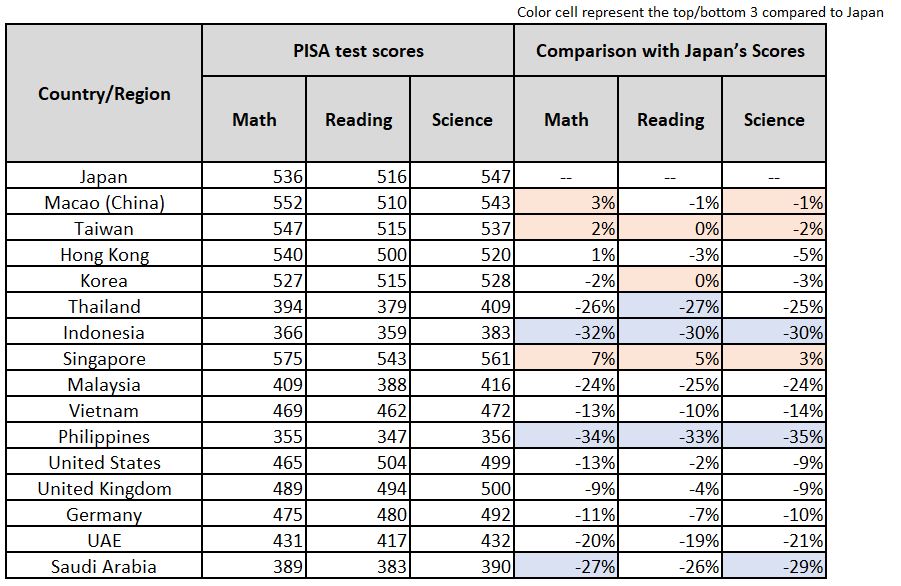
Academic Ability Test Scores_PISA _16 countries
calendar_monthJun 21, 2024
*PISA (Programme for International Student Assessment) survey is conducted every three years for 15-year-olds in the three areas of reading literacy, mathematical literacy, and scientific literacy・The PISA test was originally scheduled to be administered in 2021, but was postponed one year due to the pandemic of the new coronavirus infection. Due to exceptional circumstances such as lockdowns and school closures in many countries, data from mainland China could not be collected and data from Macau was used.・Singapore scored higher than Japan in math, reading, and science.・Macau (China) and Taiwan achieved 2-3% higher proficiency than Japan in math.・The Philippines, Indonesia, and Saudi Arabia scored about 30% higher than Japan in all subjects.---Click here to read the article that examines parenting trends and consumer insights in four countries through the lens of living spaces.[International Comparison] Differences in Child-Rearing as Seen Through Children’s Rooms: An Analysis of Educational Values in South Korea, Singapore, the United States, and India・A comparison of children’s rooms in South Korea, Singapore, the United States, and India reveals differences in each country’s educational philosophy and values regarding child-rearing.・In South Korea and Singapore, spaces are designed with a focus on learning; in the United States, spaces are designed to be free and open to encourage play and growth; and in India, child-rearing is integrated into daily life.・There are differences between these values and how child-rearing is actually carried out, and each country’s institutional frameworks and cultural backgrounds have a significant influence.
-
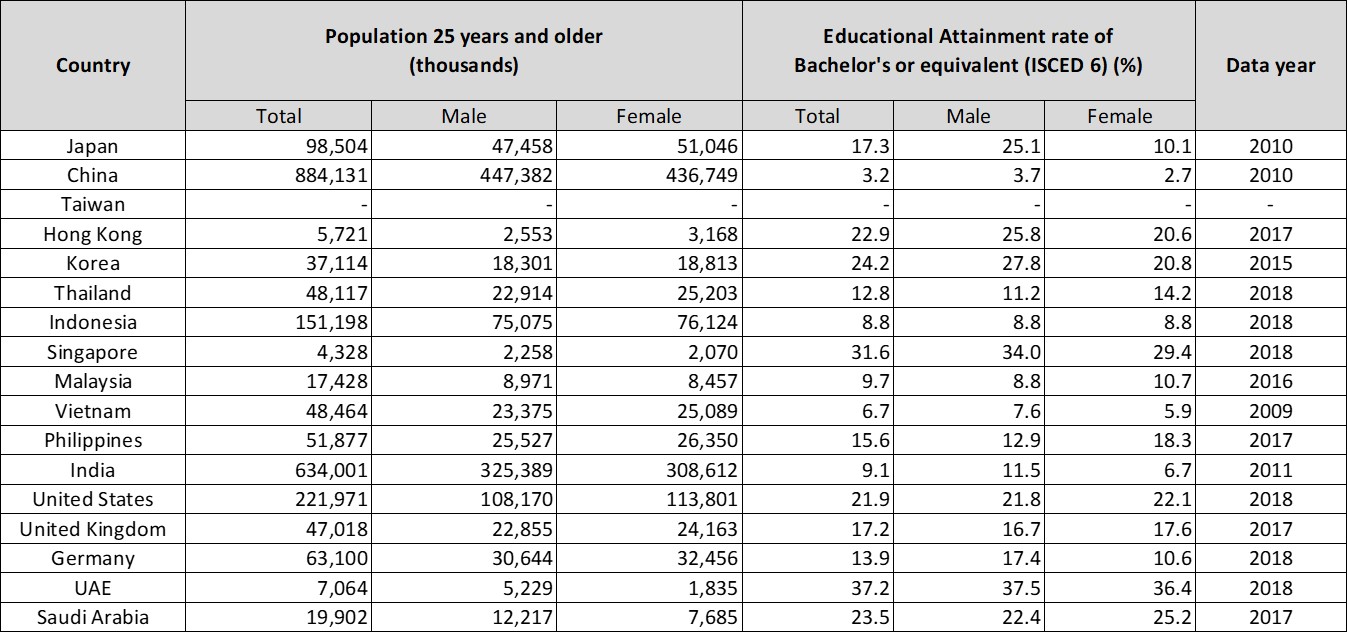
The percentage of population ages 25 and over that attained or completed Bachelor's or equivalent
calendar_monthJul 30, 2020
The UAE topped the list with 37.2%, followed by Singapore (31.6%) and Korea (24.2%). In terms of the male to female ratio, there is a large difference in Japan and India compared to other countries, with women holding a bachelor's degree about half as many as men.---Click here to read the article that examines parenting trends and consumer insights in four countries through the lens of living spaces.[International Comparison] Differences in Child-Rearing as Seen Through Children’s Rooms: An Analysis of Educational Values in South Korea, Singapore, the United States, and India・A comparison of children’s rooms in South Korea, Singapore, the United States, and India reveals differences in each country’s educational philosophy and values regarding child-rearing.・In South Korea and Singapore, spaces are designed with a focus on learning; in the United States, spaces are designed to be free and open to encourage play and growth; and in India, child-rearing is integrated into daily life.・There are differences between these values and how child-rearing is actually carried out, and each country’s institutional frameworks and cultural backgrounds have a significant influence.
-
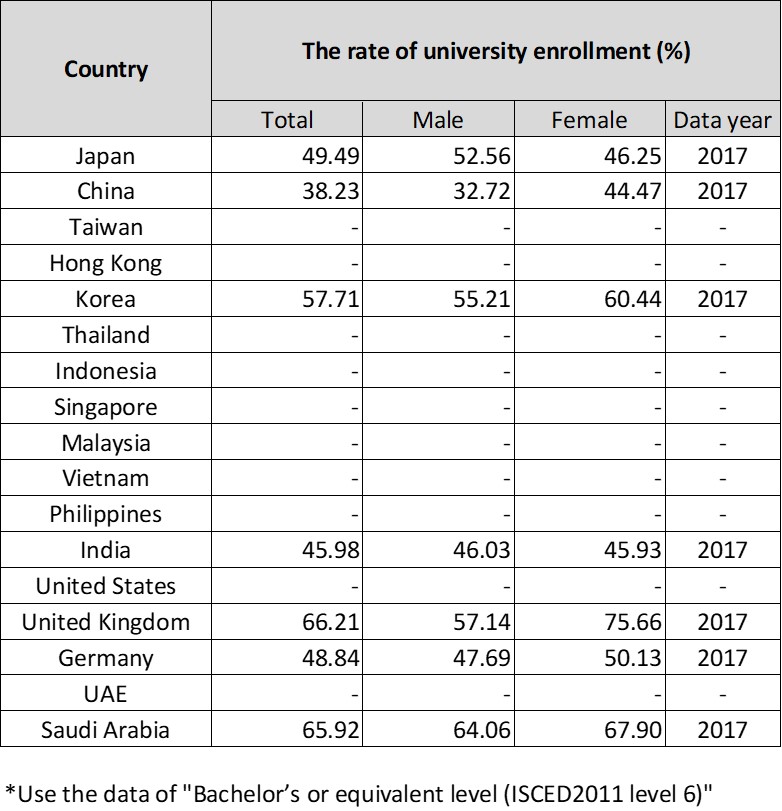
Four-year university (level) enrollment rate_7 countries
calendar_monthJul 30, 2020
The U.K. topped the list with 66.2%, followed by Saudi Arabia (65.9%) and South Korea (57.7%). Comparing men and women, there is a more than 10 point difference in the U.K. and China, the women’s university enrollment rate being higher than that of men. On the other hand, in Japan, men’s university enrollment rate is 52.5%, while that of women is 46.2%, showing that the men’s enrollment rate is higher.