“Nyam bai haui?” This is a phrase commonly used in Cambodia as a greeting, similar to “Hello.” In Japanese, it translates to “Have you eaten yet?” The fact that Cambodians use this as a greeting shows just how much importance they place on meals. Let’s take a look at the Khmer cuisine that ordinary Cambodians cook and eat at home, as well as the household chores involved.
If you’d like to learn more about home cooking and household routines in various Asian countries, please also check out this article.
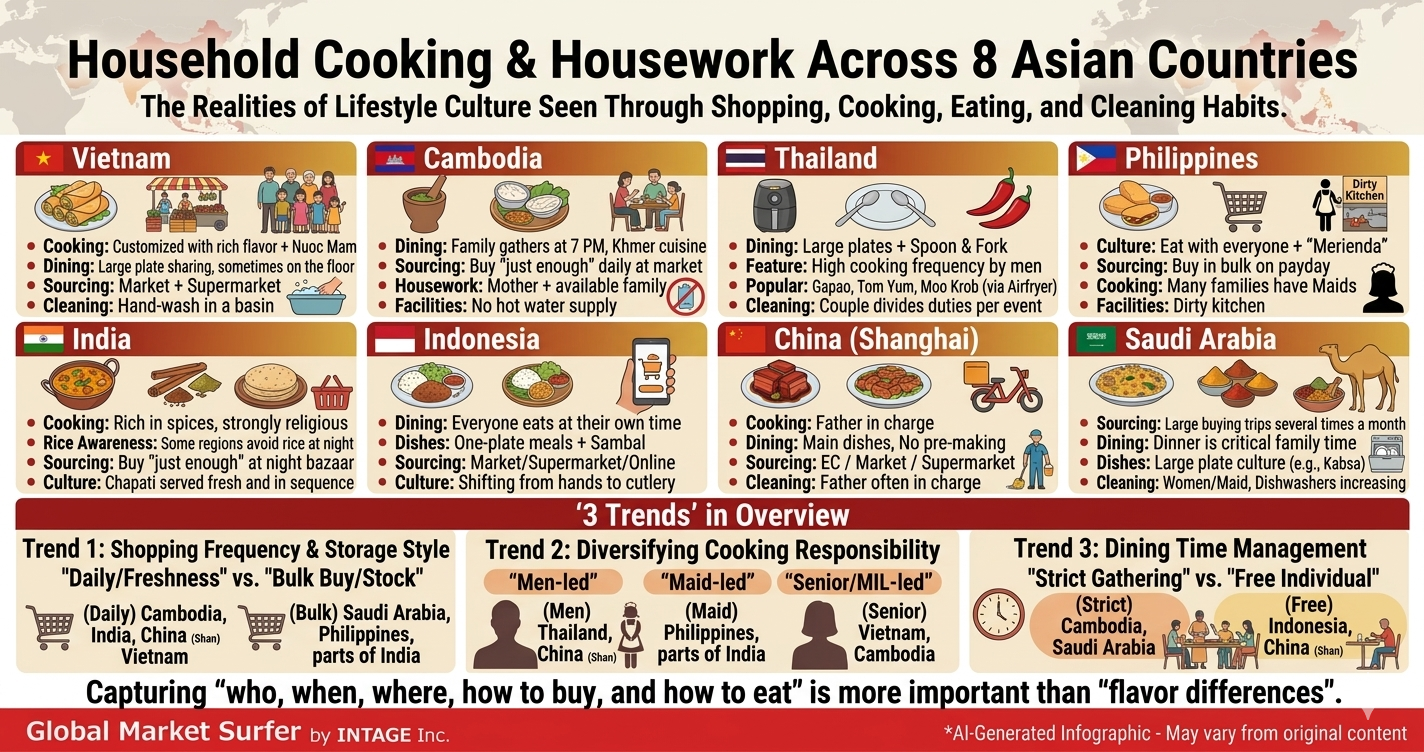
From Stocking Up on Ingredients to Cleaning Up: Home Cooking in 8 Asian Countries ~Three Trends Revealed Through Food Culture~
・Countries where groceries are bought daily vs. countries where people buy in bulk
・Seasoning and presentation styles in each country
・Who cooks? Who cleans up?
・Does the family eat together? Or do they eat whenever they like? and more
The Market That Supplies Phnom Penh’s Kitchens
In Cambodia, it is often said that people can get by without a refrigerator, as markets where they can buy fresh vegetables, meat, and fish are a common part of daily life. In the capital, Phnom Penh, in particular, markets of all sizes are scattered throughout the city. Since they are open every day except during major holidays like Khmer New Year, many housewives go to the market daily rather than stocking up in advance. The markets also serve as gathering places for casual conversation. Marie (39), who runs a small real estate company, lives at her mother’s house with her civil servant husband, their fifth-grade son, her mother, her younger sister, her older sister’s family, and their children. Since both she and her husband work, her mother prepares dinner for the large family. In Marie’s household, her mother goes to a market about a five-minute walk away every day to buy fresh ingredients like meat and vegetables.
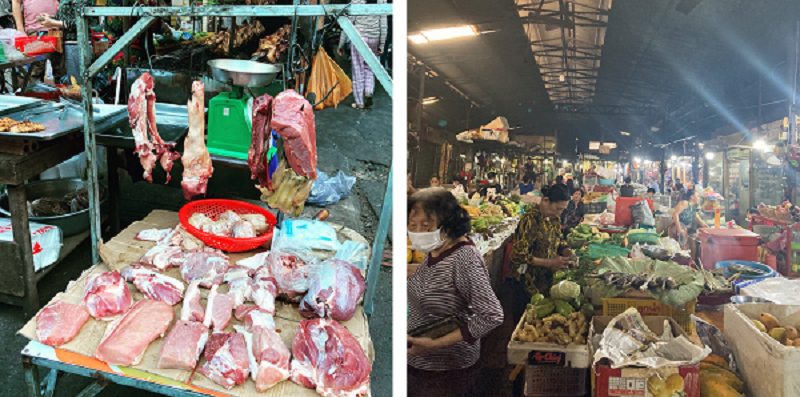
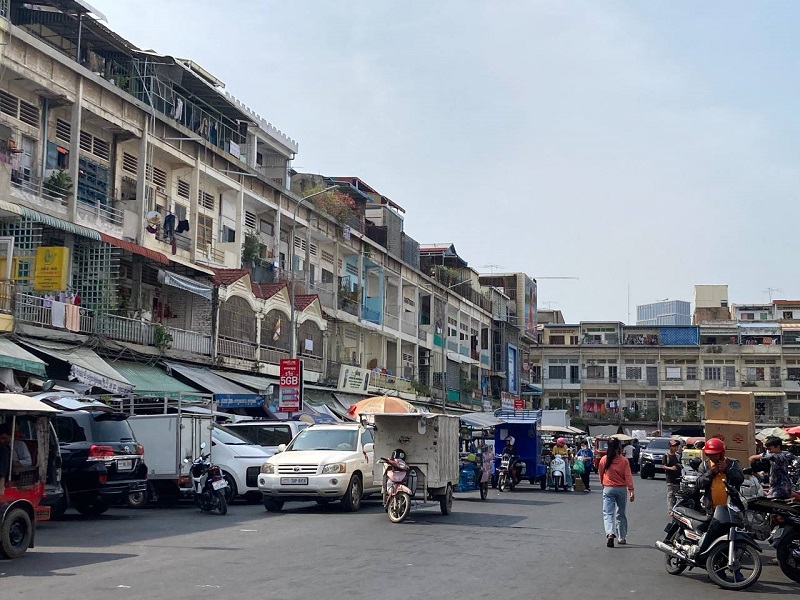
Market Conditions
A mother supporting a dual-income couple
In post-civil war Cambodia, parents in their 20s and 30s living in Phnom Penh—who were born after peace was restored—tend to spare no expense on tuition fees to send their children to private schools, even if it means stretching their budgets. As a result, many families rely on dual incomes. The family’s meals are supported by the presence of the mother, who lives with them. She cooks twice a day. While there are several food stalls operating in the alleys of Phnom Penh, they are busiest in the morning. The clientele consists mainly of businesspeople who leave home before 7:00 a.m., grab breakfast at a stall on their way to work, and arrive at the office around 8:00 a.m. In Cambodia, where lunch breaks are long (two hours for civil servants), many people return home for lunch. However, recently, in central Phnom Penh—where canteens are densely packed—more people are eating out. Marie’s mother, who tends to eat out for breakfast, prepares lunch at noon and dinner at 7:00 p.m.
Typical Khmer cuisine
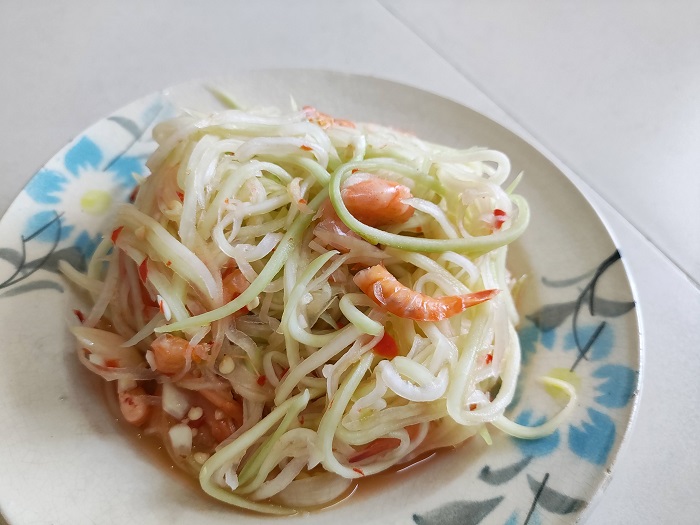
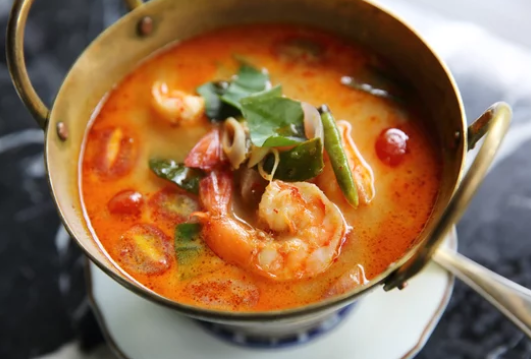
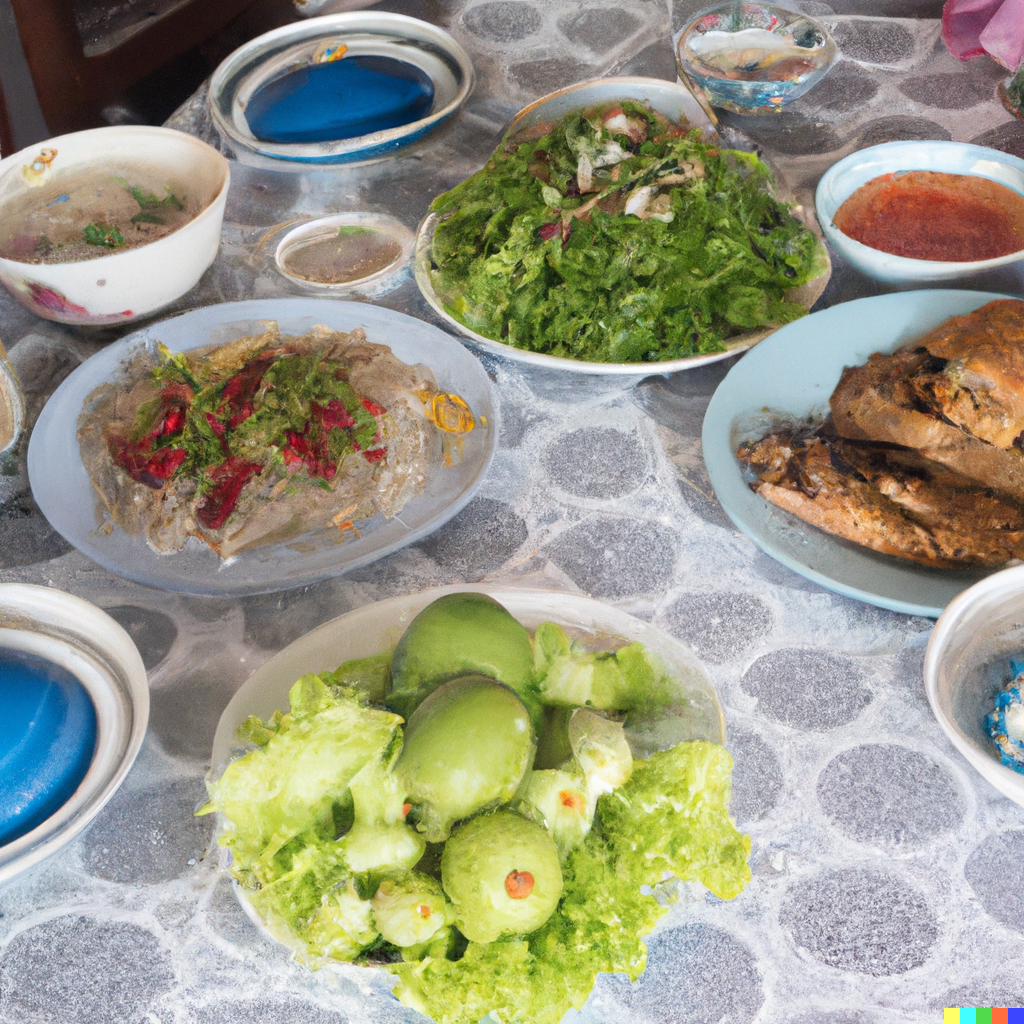
What Cambodians eat at home is known as Khmer cuisine, the local cuisine of Cambodia. While there are no strict rules regarding how to eat Khmer food, there is a typical meal that closely resembles Japan’s “one soup, three side dishes” style. First is the staple food: white rice. In Cambodia, a major rice-producing country, there is a mindset that “a meal equals rice.” Although pasta and bread are also eaten, Cambodians consider them “snacks, not a meal.” In addition to white rice, a meal is considered complete with three dishes: stir-fried vegetables or meat, and a soup. The seasoning is so salty that even people from Japan’s Tohoku region would be surprised. Khmer cuisine involves eating large quantities of white rice with just a few side dishes. Incidentally, there are few spicy dishes featuring chili peppers, unlike in Thai cuisine. Among soups, “Som Rom Chukrun” is particularly famous. A staple at Marie’s house, this sour soup features beef or river fish and water spinach, with a seasoning called “chukrun” being the key to its flavor. Chukrun is made by pounding herbs such as lemongrass, kaffir lime leaves, turmeric, and galangal in a mortar until they form a paste. As evening falls, the sound of chukrun being prepared—a rhythmic “tap, tap”—can be heard coming from homes all over the neighborhood.
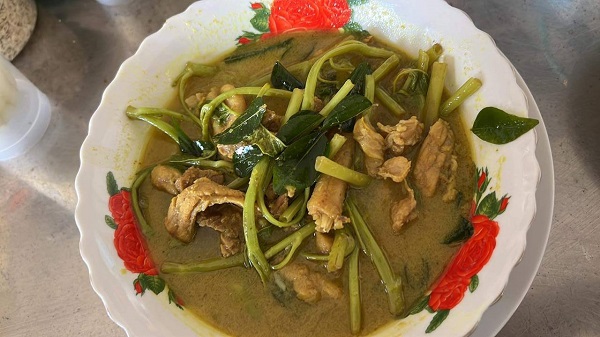
A typical home kitchen
While the standard in rural Cambodia is for houses to be built on stilts with kitchens under the eaves, things are different in urban areas like Phnom Penh. Setting aside the mansions known as “villas,” many members of the middle class live in row houses called “shop houses.”
While they may lack width, they have depth and height. In most homes, the layout consists of a combined living and dining area at the front, with the kitchen located at the very back. Rather than featuring a counter-style or island kitchen, the layout is designed so that the cook faces away from the family while preparing meals. Cooking is done using gas, and it’s common to find large gas cylinders stored right inside the kitchen. I still haven’t quite gotten used to living with these gas cylinders. Cooking utensils—such as pots and frying pans—aren’t particularly different from those in Japan, but the mortar, which is also used to make krun, is indispensable in Cambodian households. This is because there are many Khmer dishes that involve pounding garlic and various herbs before cooking. Mortars come in both wooden and stone varieties.
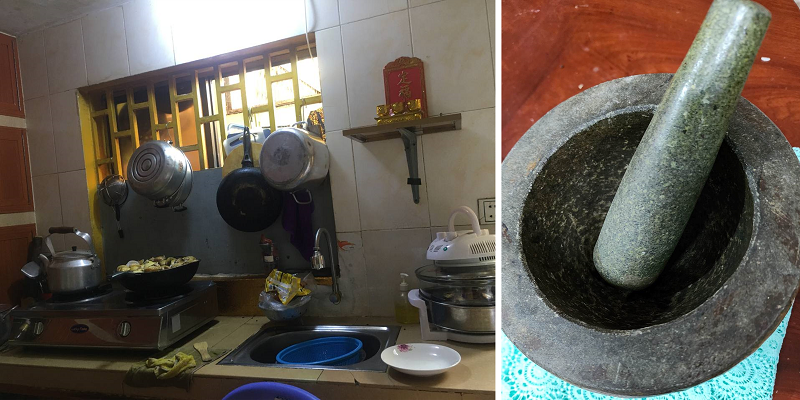
The Kitchen and the Mortar
Dinner is a time for family togetherness
Khmer cuisine is typically served family-style. Two or three side dishes are arranged in the center of the table, and each person serves themselves from these dishes onto their own plate of white rice. Some families serve soup in separate bowls, while others simply pour it directly over the rice. This same style of dining is common in restaurants as well. Since everyone shares the dishes, it is common in Cambodia for the entire family to eat dinner together. Since the social culture generally does not involve overtime work, the family is usually gathered by 7:00 p.m. After the meal, whoever is free takes the dishes to the kitchen and washes them by hand with water and detergent. Typical Cambodian households do not have water heaters, so there is no custom of washing dishes with hot water (showers are also generally cold). One advantage of serving food on large platters is that there aren’t that many dishes to wash. In typical Phnom Penh households with large families, chores are often shared among family members. It seems to be a cultural norm here where children grow up understanding that it is not just the mother who does the housework, but that the father and, of course, the children also help out with household chores.
In Cambodia, dinner is a time for family togetherness, but people tend to be very welcoming of guests joining them. I myself have visited Marie’s home many times and shared meals with her family.
I make it a point to help clean up before I leave. I believe that’s how I can truly become part of the culture where, once you’ve shared a meal, you’re already chatting with the family, asking, “How was your meal?”