Commentary
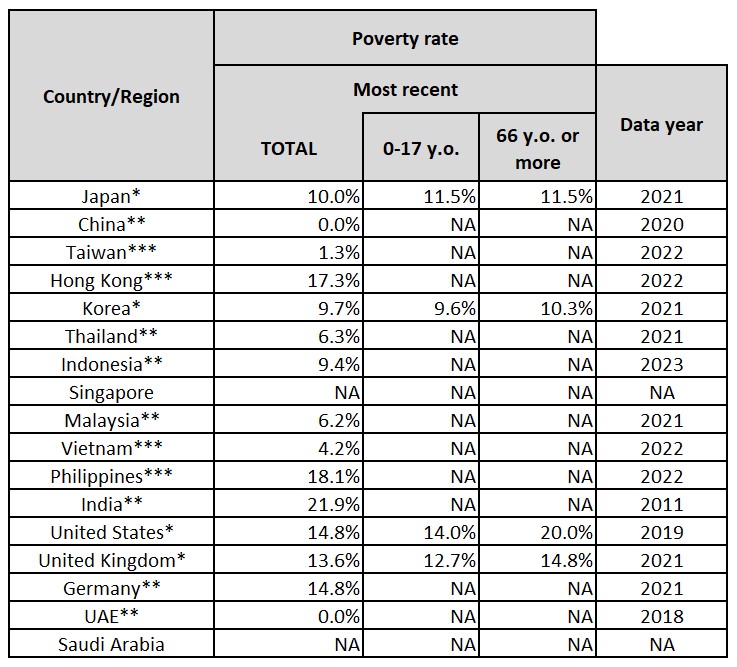
Among the 15 countries/regions with available data, the highest poverty rates are the India (21.9%), Philippines (18.1%), Hong Kong (17.3%), the United States (14.8%), and Germany(14.8%).
Poverty rates in China and UAE are reported at 0.0%.
---
Generation Z, which accounts for about a quarter of the world’s population, is garnering attention as the largest consumer demographic of the future.
In this article, we use Intage’s consumer database “Global Viewer” to compare Generation Z across 10 Asian countries and explain their commonalities and differences.
Understanding Generation Z Around the World: Country-Specific Trends Through Values and Daily Life
・Generation Z’s Values (Health, Parenting, Shopping, etc.)
・Generation Z’s Lifestyle
Reference
Reference
* OECD Data, Poverty rate
The poverty rate is the ratio of the number of people whose income falls below the poverty line;
taken as half the median household income of the total population
Retrieved Oct. 31, 2024, from
here** World Bank Data, Poverty headcount ratio at national poverty lines (% of population)
Data are compiled from official government sources or are computed by World Bank staff using national (i.e. country–specific )poverty lines.
Retrieved Oct. 31, 2024, from
here UAE :
https://data.worldbank.org/country/AE*** The Asian Development Bank (ADB), Basic 2024 Statistics, Propotion of population living below the national poverty line (%)
This represents the percentage of the total population living below the national poverty line based on the specific economy’s data
Retrieved Oct. 31, 2024, from
here
Commentary
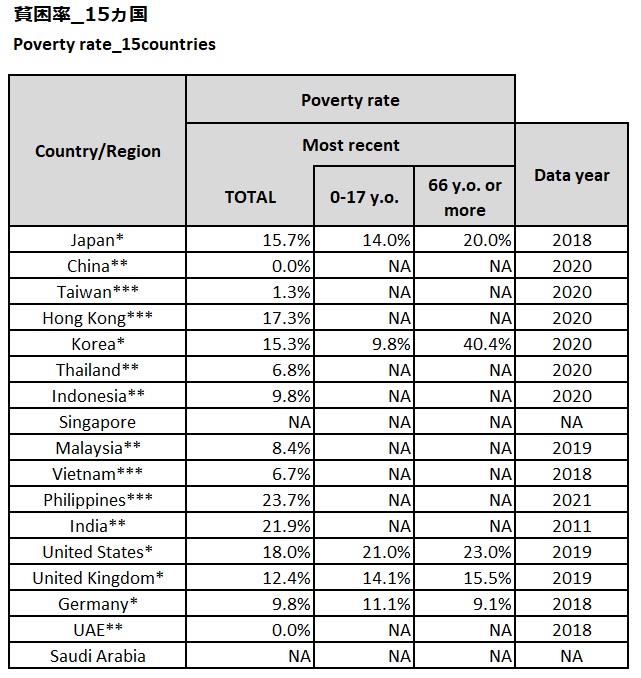
Among the 15 countries/regions with available data, the highest poverty rates are the Philippines (23.7%), India (21.9%), the United States (18.0%), and Hong Kong (17.3%). Poverty rates in China and UAE are reported at 0.0%.
Reference
* OECD Data, Poverty rate The poverty rate is the ratio of the number of people whose income falls below the poverty line; taken as half the median household income of the total population Retrieved Sep. 30, 2022, from https://data.oecd.org/inequality/poverty-rate.htm ** World Bank Data, Poverty headcount ratio at national poverty lines (% of population) Data are compiled from official government sources or are computed by World Bank staff using national (i.e. country–specific )poverty lines. Retrieved Sep. 30, 2022, from https://data.worldbank.org/indicator/SI.POV.NAHC https://data.worldbank.org/country/AE *** The Asian Development Bank (ADB), Basic 2022 Statistics, Propotion of population living below the national poverty line (%) This represents the percentage of the total population living below the national poverty line based on the specific economy’s data Retrieved Sep. 30, 2022, from https://www.adb.org/sites/default/files/publication/788161/basic-statistics-2022.pdf