Global Market Surfer
 CLP
CLP Column
The Indonesian Road Less Travelled (Because Someone Didn't Hand Her the Keys)
- Release date: Feb 05, 2026
- Update date: Feb 05, 2026
- 1040 Views
Let’s embark on a whimsical journey titled "Where's the STNK?" — yes, it’s that all-important vehicle registration certificate in Indonesia! If you’re a woman in this dynamic nation, prepare for a rollercoaster of intrigue and complexity.
In the bustling urban jungles of Jakarta, Surabaya, and Medan, a subtle yet powerful story unfolds. Picture this: car keys teasingly out of reach while heartfelt offers of “Don’t worry, I’ll drive you,” transform into unintentional roadblocks. And thus, many women find themselves navigating life without the freedom that comes from vehicle ownership.
A recent revelation from a thought-provoking survey by Intage Indonesia — which surveyed 400 wealthy households with incomes soaring above IDR 8 million — casts light on this conundrum. It confirms what countless women have suspected: the journey toward equality resembles a traffic jam at rush hour — filled with well-meaning intentions but packed with unexpected delays. Let’s dig into the experiences of these remarkable women, as illustrated by the data.
1.The Wealth of Mobility: Ibu Sari's Comedic Odyssey

Meet Ibu Sari, a spirited 45-year-old matriarch of her South Jakarta household. Armed with a master’s degree and an uncanny knack for juggling multiple tasks — she could give a circus performer a run for their money. Yet, despite her impressive skill set, her mobility is about as elusive as finding a parking spot on a busy day.
Two decades ago, her husband made a bold promise: “Don’t worry, I’ll drive you anywhere.” Ah, romance!
But as the years rolled on and the kids marched off to school, she yearned to grab the wheel herself. Alas, her mother-in-law chimed in drily, “Untuk apa? Kan ada sopir. Lagian jalanan Jakarta itu berbahaya untuk perempuan,” (Why bother? We have a driver. Besides, Jakarta’s roads are unsafe for women.)
So, Ibu Sari now orchestrates her life around her husband’s schedule, the family driver’s availability, and the whims of online transport apps like Gojek. Frustration strikes like a lightning bolt when emergencies arise, such as needing to rush her son to the doctor while her husband is away — and the driver is mysteriously MIA.
The Data Speaks:
Ibu Sari represents the 15.6% of women without a driving license. Her experience is a classic example of “I could have been a contender,” where a lack of driving leads to an absence of need, resulting in the perception that driving itself is a far-off dream.
2.The ‘His’ and ‘Hers’ Mirage: Andini’s Story
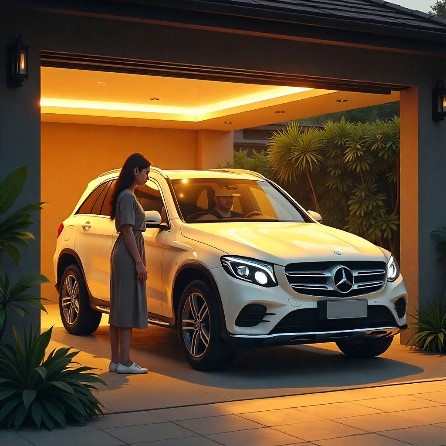
Now, let’s meet Andini, a vibrant 32-year-old marketing manager from Surabaya, enjoying a life that appears to shine like a polished car hood. With a household income comfortably exceeding IDR 20 million and the prized joint ownership of a car with her husband, her life is a sitcom waiting to season. But, hold on a second – there’s a twist!
When the couple applied for a car loan, the bank officer flashed a smile and directed all questions to her husband — the designated “man of the hour.” Consequently, the loan and STNK now proudly bear his name. Andini, it seems, is relegated to the role of weekend driver, accessing the car only during family outings based on her husband’s grand plans. During the week, it’s a dash on motorbike taxis for her, while the family car sits cozily idling in her husband’s office parking lot, perhaps having existential thoughts.
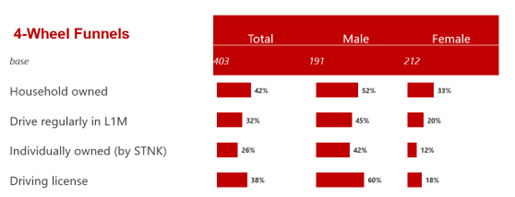
The Data Reveals: Andini is among the 33% of women who report having access to a car in the household, yet she’s part of the 11.8% who lack personal ownership. Interestingly, women influence nearly 70% of car purchases in Indonesia, especially in financing decisions, but economic frameworks keep her sidelined. It’s like being a co-star without any lines!
11カ国の定量データを即座に活用Global Viewer
世界11カ国・数万人規模のアンケート結果を凝縮した「定量ストックデータ」サービスで、主要カテゴリーの購買行動や意識を国間比較分析。ゼロから調査を企画する時間を省き、スピーディーに対象者理解。
A Deeper Dive: Not All Women Are in the Same Passenger Seat
Taking a closer look at the data exposes a multifaceted narrative where mobility experiences vary as wildly as traffic patterns, revealing class distinctions and generational trends.
The Wealth Divide:
For women, an increase in wealth doesn’t always equate to a joyride down Easy Street. The statistics give us a sobering laugh:
- Car License Holders: A mere 37.3% of women in the Upper-I class possess a car license, dramatically contrasted by just 10.5% in the Middle-Upper group.
- Car Ownership: A staggering 25.4% of Upper-I women own a car, nearly four times higher than the Middle-Upper ladies (6.5%).
While money can’t buy happiness, in Indonesia, it significantly influences the odds of securing a driver’s license and owning a vehicle. For Upper-I women, the road to mobility feels less like off-roading, but still fraught with bumps compared to their male counterparts in the same class.
The Age Factor:
Examining different age groups unveils some intriguing tidbits:
- Ownership vs. Age: Car ownership peaks for women aged 41-45 (15.6%) but takes a nosedive for those aged 25-30 (8.1%). It appears that with age, ownership comes — along with the accumulated wisdom to navigate the ups and downs of life.
- Licensing Disparity: Notably, the highest percentage of women without driving licenses is found in the 36-40 and 41-45 brackets (over 24% each). This demonstrates that the challenge knows no age bounds; it’s a communal puzzle that spans generations.

-

Author profile
Tika Widyaningtyas
Senior Research Manager
A market researcher at Intage Indonesia who knows the country's roads intimately—she spends two hours driving to the office and five hours driving to her hometown every weekend. Her fascination with mobility might have begun at 17 when she let her crush ride her new motorbike, a decision that ended in stitches and an early lesson in market segmentation: not everyone who wants to ride actually can.