 Global Market Surfer
 CLP
CLP Column
Do countries with high health awareness actually have longer healthy lifespans? Which countries have high health awareness?
- Release date: Mar 11, 2026
- Update date: Mar 11, 2026
- 50 Views
- Food
- Health
- Singapore
- China
- Thailand
- Indonesia
- Korea
- Hong Kong
- Malaysia
- Philippines
- Asia
- Taiwan
- Viet Nam
- ASEAN

1. Introduction
What does it mean to be health-conscious? Probably not many people can answer that immediately. Eating nutritionally balanced meals, incorporating regular exercise into daily life, avoiding stress buildup, preventing illness—I imagine people would give various answers. According to the WHO (World Health Organization), health*1 refers to “a state of complete physical, mental, and social well-being, not merely the absence of disease or infirmity.”
On May 15, 2025, the WHO released the World Health Statistics (2025 edition). Among 198 countries ranked globally, Singapore took first place (73.6 years), Japan second (73.4 years), and South Korea third (72.5 years), with Asia occupying the top three positions. Other major Asian countries' healthy life expectancy rankings were: China 28th (68.6 years), Thailand 46th (65.8 years), Vietnam 50th (65.4 years), Indonesia 117th (60.7 years), and the Philippines 130th (58.8 years).*2
*1 https://japan-who.or.jp/about/who-what/identification-health/
*2 https://memorva.jp/ranking/unfpa/who_whs_healthy_life_expectancy.php (2025年10月24日)
Is healthy life expectancy the only health indicator? Health can also be assessed through physical activity and diet. Furthermore, health awareness likely varies from country to country. This article will therefore examine the characteristics of health awareness across Asian nations.
2. Health Awareness in Asian Countries
Based on Intage's Global Viewer data (2024 survey) of overseas residents, we compared health awareness across Asian countries. The target countries were China, South Korea, Taiwan, Hong Kong, Singapore, Malaysia, the Philippines, Indonesia, Thailand, and Vietnam.
Health awareness for each item was assessed using a 5-point scale ranging from “Strongly Agree” to “Strongly Disagree.” The percentage of respondents who selected “Strongly Agree” (TOP1) and the ranking for each country are as follows:
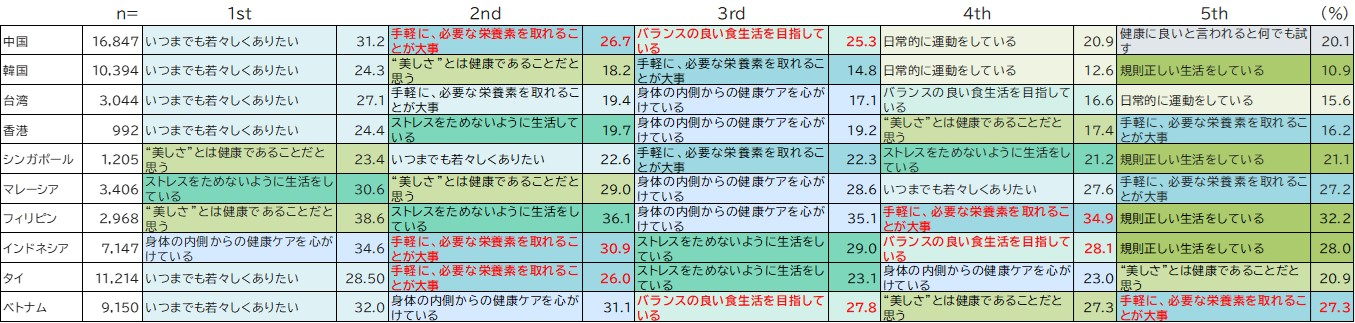
Figure 1: Health Awareness by Country (TOP1) *Top 5 from each country
Source: INTAGE Global Viewer (2024)
Accelerate decision-making with smart overseas resident data
Global Viewer
This service provides reports tailored to your issues using questionnaire data on various actual conditions and attitudes of sei-katsu-sha in 11 countries (Asia and US) stocked by INTAGE.
The service covers 400 items, including actual behavioral conditions and awareness, values, and information contact related to various product and service categories.
First, a notable characteristic was that the top five items were nearly identical for both South Korea and Singapore. They shared the following common points: “Wanting to stay youthful forever,” “Believing ‘beauty’ means being healthy,” “Considering it important to easily obtain necessary nutrients,” and “Maintaining a regular lifestyle.” The content of the top two items in both countries reveals a high level of beauty consciousness.
(1) Diet
Particularly noteworthy is the awareness regarding food. Countries where awareness regarding food exceeded 25% (shown in red) were China, the Philippines, Indonesia, Thailand, and Vietnam.
When examining the same data on dinner preparation frequency, the countries where over 60% of respondents “prepare dinner at home 4 or more days per week” on weekdays and over 50% “prepare dinner at home every holiday” on weekends matched the five countries mentioned above (China, the Philippines, Indonesia, Thailand, and Vietnam). This indicates that heightened awareness about food is reflected in actual behavior, a characteristic clearly visible in the data.

Figure 2: Frequency of Cooking Dinner at Home on Weekdays (Daily + 4-5 days or more per week total)
Source: INTAGE Global Viewer (2024)

Figure 3: Frequency of Cooking Dinner at Home on Holidays (Daily (Holidays))
Source: INTAGE Global Viewer (2024)
While we cannot definitively conclude a causal relationship between dietary awareness and cooking frequency based solely on this data, we can infer that the two factors are likely interrelated and exhibit a synergistic effect. A high frequency of home cooking also indicates a concern for nutritional balance and avoiding dietary imbalances. This suggests a high level of dietary awareness among the five countries mentioned above (China, the Philippines, Indonesia, Thailand, and Vietnam).
(2) Movement Surface
On the other hand, how about physical activity?
More than 25% of people (one in four or more) engage in sports on their days off in five countries: China, Hong Kong, Singapore, Malaysia, and Vietnam. Notably, China and Vietnam, as mentioned earlier, are among the countries with high dietary awareness, suggesting particularly strong health consciousness.

Figure 4: Percentage of People Engaging in Sports on Holidays
Source: INTAGE Global Viewer (2024)
3. Summary
The data revealed that China and Vietnam exhibit particularly high health consciousness in both diet and exercise. Conversely, South Korea and Singapore—countries expected to have longer healthy lifespans—seem to prioritize beauty consciousness over health awareness. While this may appear contradictory at first glance, it likely stems from the significant advantages afforded by advanced nations, such as developed medical systems.
It may not be that high health consciousness leads to longer healthy lifespans, but rather that the actual correlation is this: because the technology exists (such as advanced medical care) to enable longer healthy lifespans, people can live longer even with lower health consciousness. People in so-called emerging countries like China, the Philippines, Indonesia, Thailand, and Vietnam likely consciously maintain healthy eating habits in their daily lives, without relying on such technology. Comparing health behaviors across countries, as we do here, offers a glimpse into the strength of people's efforts to stay as healthy as possible.

-

Author profile
Hiromi Shimizu
Since 2020, I have worked as a researcher, gaining experience in surveys across a wide range of industries including FMCG, durable goods, and services. I currently focus primarily on the durable goods sector.
I started running after taking up walking during the pandemic to maintain my health, and now I'm challenging myself with full marathons. My frequent foot injuries are a concern. -
Editor profile
Chew Fong-Tat
Malaysian researcher who has lived in Japan for 14 years and has handled many surveys on ASEAN countries.