 Global Market Surfer
 CLP
CLP Column
National Character of Countries Around the World United States: The Reality of LA-Style Lifestyle Consumption Reflected in “Visible Health”
- Release date: Mar 18, 2026
- Update date: Mar 18, 2026
- 47 Views
It is difficult to describe the United States as having a single national character. Under its federal system, regions with vastly different histories, racial compositions, religious views, and political leanings coexist; it is more accurate to view the country as a “collection of nations with differing values.” Nevertheless, a culture that values rationality, personal responsibility, and respect for individual choice is a common trait found across many regions.
Within this context, Los Angeles (hereinafter LA), California, is a city with a unique character. If I were to describe this city, where I live, in a single phrase, it would be “Visible Wellness.” Here, value is placed not merely on being healthy, but on “appearing to be healthy.”
目次
1. Smoothies are not just drinks; they are also a statement of lifestyle
2. Clean Eating is not just a daily practice—it’s a way of life
3. A City Where Athleisure Becomes Everyday Wear
4. “Your own comfort” over “what others think”
5. Why In-N-Out Still Has Such a Loyal Following
6. How “Visible Health” Shapes Consumer Behavior
1. Smoothies are not just drinks; they are also a statement of lifestyle
Erewhon is a symbol of the wellness trend in Los Angeles. It is a high-end supermarket specializing in organic and non-GMO foods, and its signature smoothies are pricey, costing around $20 (about 3,000 yen) each. Even so, the store is always bustling with customers.
Source: Erewhon Official Instagram
The shelves are lined with labels such as “gluten-free,” “dairy-free,” and “sugar-free.” What matters here isn’t just “what’s in it.” It’s the fact that “what’s not in it” is clearly stated. Transparency regarding ingredients and ethical standards are the key criteria, rather than price.
In LA, health isn’t limited to personal effort. It’s treated as a visible part of one’s lifestyle within society. The very act of holding a smoothie serves as a sign that says, “This is the set of values I live by.”
2. Clean Eating is not just a daily practice—it’s a way of life
Juice cleanses and the cold-pressed juice culture are nothing out of the ordinary in LA. The city is lined with specialty cold-pressed juice shops, and terms like “detox” and “cleanse” are part of everyday conversation.
Source: Pressed Juicery Official Instagram
Even more striking is the extensive selection on the supplement shelves. Products—ranging from protein powders and gut-health supplements to plant-based beverages—are meticulously categorized, reflecting how the concept of “optimizing the body” has become widely accepted. Here, one can observe a culture of rigorous self-management that stems from a rational mindset.
I, too, have been taken aback by LA’s food culture. At a barbecue with a vegetarian friend, I was expected to be considerate enough to use separate grills for meat and vegetables. This is because these choices are based not merely on personal preference, but on values and ethics. Those around them accept this as a given.
Furthermore, a vegan friend once told me, “Processed foods that just happen not to contain animal ingredients cannot be considered products based on a philosophy.” The criteria for judgment extend beyond whether the ingredients meet certain standards to include the brand’s ideology and background. In LA, the question of “how something is made” is considered more important than “what is eaten.”
Even when choosing a restaurant for a birthday party, it has taken time to find a place because the group includes people with different dietary guidelines—such as non-GMO, ketogenic, and vegan. In LA, “making choices that each person can feel good about” takes priority over “everyone eating the same thing.”
3. A City Where Athleisure Becomes Everyday Wear
The values of Visible Wellness extend beyond food. When you walk through the city, they are clearly reflected in people’s clothing as well.
“Athleisure” is a portmanteau of “athletic” and “leisure,” but in LA, the line between the two is virtually nonexistent.
Leggings paired with long socks and chunky sneakers. A light hoodie thrown over a cropped top or sports bra. Such outfits are seen not only at the gym, but in every aspect of daily life—at cafes, supermarkets, and while dropping off or picking up children.
Source: Alo Official Instagram
Once you step into a clothing store, the extent of this trend becomes even clearer. It’s not uncommon to see floor space divided almost evenly—or even more so—between regular apparel and activewear. Leggings, sports bras, hoodies, and workout tops take center stage, with features like functional fabrics, stretch, and moisture-wicking properties prominently highlighted.
Walking through the city, you frequently see logos from brands like Lululemon and Alo. Even if a single pair of leggings costs around $100 (about 15,000 yen), it is not viewed merely as workout gear but as “a choice to invest in one’s body.” The deciding factor is not the price, but whether the item aligns with one’s lifestyle.
People nourish their bodies through food and choose clothing that allows them to present their bodies naturally. It is precisely because of this cycle that athleisure is not a fleeting trend but has become firmly established as a way of life.
4. “Your own comfort” over “what others think”
When discussing LA’s approach to fashion, one essential aspect is the mindset of prioritizing “personal comfort” over “how others perceive you.”
In Japan, there are many situations where people unconsciously consider whether their attire suits the occasion or complements their body type. For example, there’s an unspoken rule that crop tops are only for those with toned figures. In LA, however, that assumption isn’t nearly as strong. People choose cropped tops regardless of their body type, and the same goes for leggings. Such choices rarely draw special attention.
Underlying this is a culture of “non-judgment” in the best sense of the word. There is a sense of distance maintained: one’s own choices belong to oneself, and others’ choices belong to them.
As a result, standards for clothing also shift. Practicality over formality, functionality over appearance. Sneakers over heels, stretch fabrics over tight-fitting clothes. Rationality is directly reflected in clothing. Here, too, American culture—which values self-determination and personal responsibility—shines through.
“Visible Wellness” isn’t simply about showing off a toned body. It’s about choosing for yourself, taking care of yourself, and expressing that state naturally. That attitude is what’s being visualized as part of the cityscape.
5. Why In-N-Out Still Has Such a Loyal Following
When people talk about health consciousness in LA, the focus tends to be on things like veganism and smoothies. But there’s another iconic sight on the streets: the lines at In-N-Out. It’s not just tourists lining up—local young people and families do too. The menu is extremely simple, consisting only of hamburgers, cheeseburgers, fries, and milkshakes. There’s no excessive customization or health-conscious marketing. Yet it still enjoys a strong following.
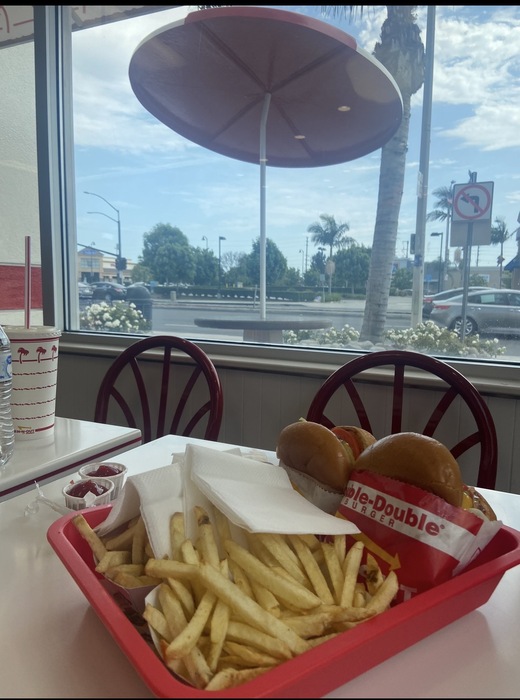
In-N-Out
Source: IN-N-OUT Official Website
At first glance, this phenomenon might seem to contradict Visible Wellness’s values. But in reality, there is a certain LA-style logic to it. In-N-Out is committed to “simplicity.” Its ingredients are relatively straightforward, and by keeping the menu limited, it maintains quality control. It doesn’t run massive advertising campaigns or engage in excessive marketing gimmicks. In a sense, it’s a “clean-cut” brand.
What LA consumers value isn’t necessarily just “low-calorie” or “vegan” options. What matters is whether that choice aligns with their personal values. They might drink smoothies, take supplements, and work out in leggings on a regular basis. But sometimes, they enjoy a burger. That choice, too, is one they make for themselves.
What we see here isn’t a compulsion to “be healthy.” It’s a sense of “being in control.”
A sense of control, rather than perfection.
In LA, health isn’t about stoic self-denial; it’s an extension of self-determination. That’s why smoothies and In-N-Out coexist without contradiction.
6. How “Visible Health” Shapes Consumer Behavior
In LA, health is expressed less as an internal effort and more as a lifestyle shared with others. Shopping at farmers’ markets, enjoying a salad lunch on a terrace, and walking around with a smoothie in hand. And the functional attire of leggings and sneakers. All of these are also self-expressions of the values that define “how I want to be.”
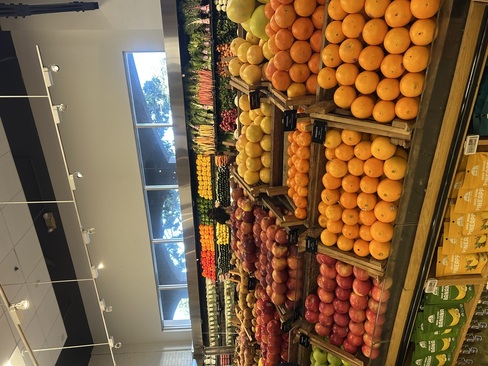
Inside Erewhon
People nourish their bodies through food and choose clothing that allows them to present their bodies naturally. This approach is driven by a rationality that prioritizes alignment with one’s lifestyle over price. At the same time, the sense of being in control—which includes occasionally choosing a burger—is highly valued. In LA, health is not about perfection, but rather the accumulation of self-determination.
Even within the United States, speed and efficiency are often prioritized in New York. In contrast, in LA, the attitude of taking time to engage with one’s body and values is more readily appreciated. While both cities have cultures that emphasize rationality and personal responsibility, the “direction of that rationality” differs.
Understanding the LA market is not simply a matter of introducing healthy foods or activewear. What matters is crafting a narrative around the question: “What kind of person can I be by choosing this?” Visible Wellness is not a product category; it refers to the very structure through which people express themselves through consumption.
The United States is a collection of diverse values coexisting side by side, and LA is merely one strong context within that. However, in this city, the concept of health is transformed into a “visible form” through food and clothing. Therein lies the essence of the LA market.


-

Author profile
TNC Lifestyle Researcher
I have lived in Los Angeles for over 10 years. After working as a news anchor in Japan, I moved to the United States. Currently, as a mother of one, I live in LA and am dedicated to sharing the appeal of Japanese cuisine with the local community, driven by my passion for it.
-

Editor profile
Chew Fong-Tat
Malaysian researcher who has lived in Japan for 14 years and has handled many surveys on ASEAN countries.
Other related article:
-

National Character of Asian Countries: Australia Edition: A National Character Rooted in Mateship and a Coexistence Lifestyle
-

National Character of Countries Around the World Brazil: A cheerful and friendly national character born from diversity and resilience
-
National Character of Countries Around the World South Korea: The “Hurry-Hurry Culture” Born from an Impatient National Character, Prioritizing Speed