目次
- 1. Introduction
- 2. Basic Profile of Thailand: Demographics, Income, and Urbanization
- 3. Thai Consumers' Values: Practicality, Self-Improvement, and Word-of-Mouth
- 4. Changing Eating Habits: From “Eating Out” to “Eating at Home” and Beyond
- 5. Growing Health Awareness and the Rapidly Expanding Supplement Market
- 6. Unique Thai Spending Habits: Lavish Weddings
- 7. Mobility Trends: Government-Led Shift to EVs
- 8. Conclusion
1. Introduction
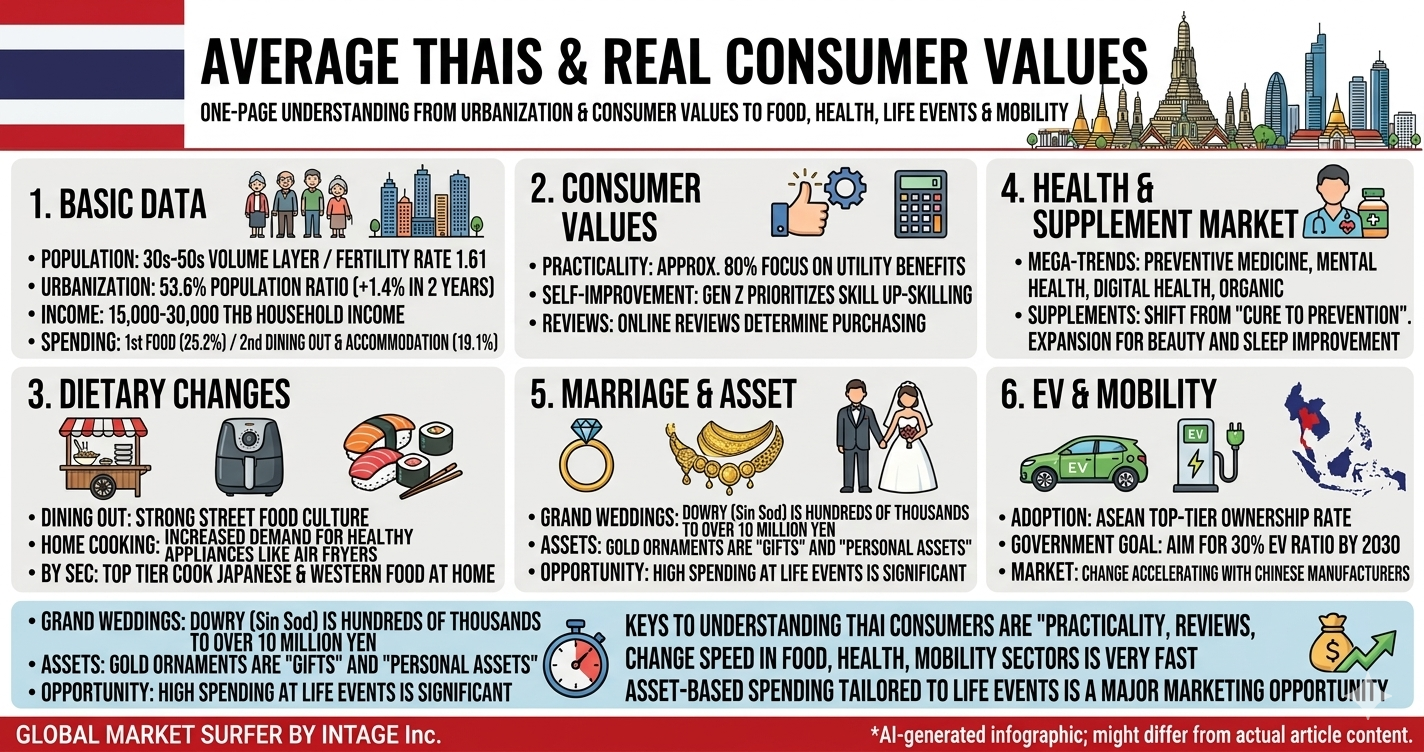
Among Asian countries, Thailand stands out for its unique economic growth and rapid digitalization. To create marketing campaigns that resonate with local consumers, it is essential to first understand their “various averages” and “basic profiles.”
In this article, we will examine Thailand’s demographic trends, consumer characteristics, and recent lifestyle trends based on survey data from Intage’s international consumer databases, “Global Viewer” and “Consumer Life Panorama.” Let’s cover the essential information needed to understand the Thai market.
2. Basic Profile of Thailand: Demographics, Income, and Urbanization
First, we will present some basic data on Thailand’s demographic structure, life stages, and the purchasing power of target demographics—information that is essential for developing a marketing strategy.
(1) Signs of a Declining Birth Rate and an Aging Population, and the Demographic Core
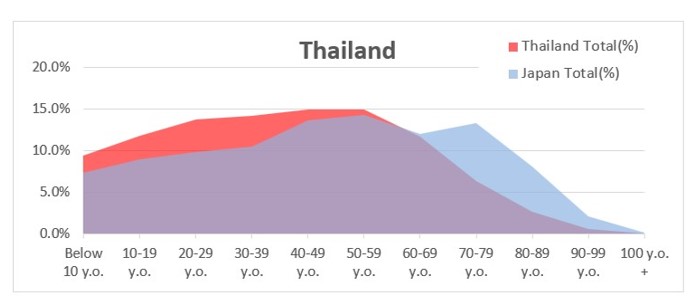
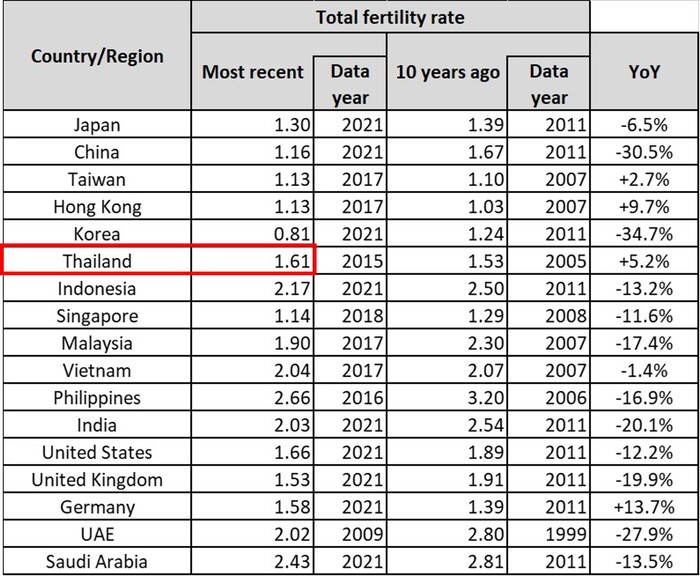
While people in their 40s to 70s make up the demographic core in Japan, in Thailand the core is centered on those in their 30s to 50s, with the population being relatively smaller among younger age groups, from teenagers and younger to those in their 30s. The fertility rate stands at 1.61 (2015) and, while showing an upward trend compared to the past, a declining birthrate is evident, similar to Japan (1.30, 2021). Going forward, changes in the population structure will continue, and it will be necessary to take the progression of aging into account in the future.
Please see here for detailed data.
▶Related data:Population/population ratio by age and sex (10 y.o. range) _Thailand
▶Related data:Total fertility rate_17 countries
(2) Rapid Urbanization and Life Stages
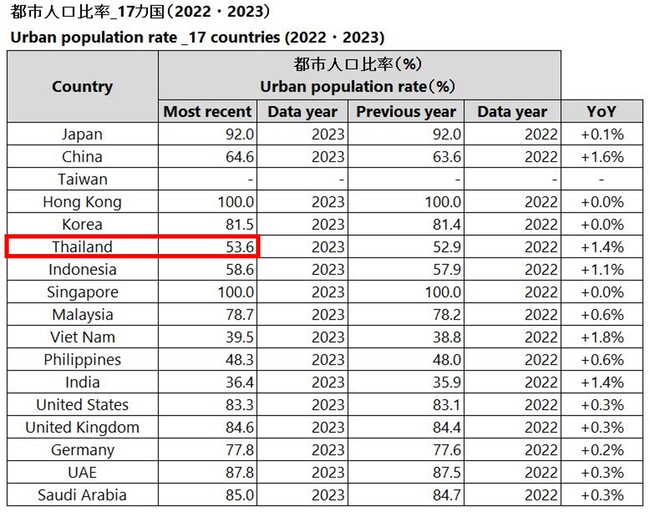
Thailand’s urban population ratio stands at 53.6%, which is roughly half that of Japan (92.0%). However, the pace of urbanization is accelerating; over the past two years, the urbanization rate has increased by 1.4%, marking the third-highest growth rate among the countries surveyed, following Vietnam (1.8%) and China (1.6%). Going forward, as urbanization progresses, urban lifestyles and consumption patterns are expected to become even more widespread.
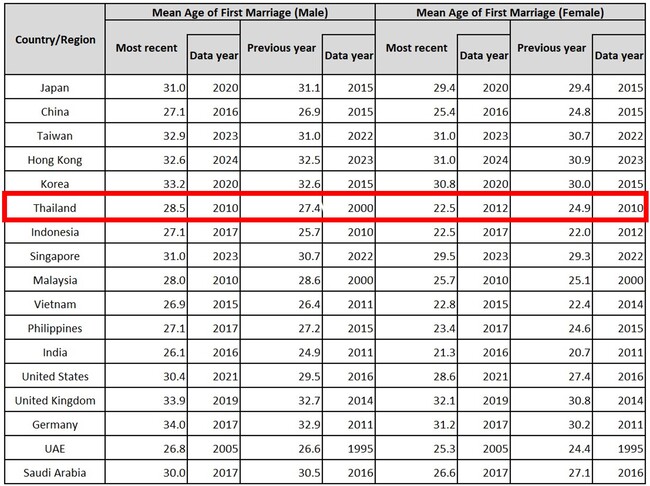
Additionally, the average age at first marriage for men is 28.5 years, which is lower than in Japan (31.0 years) but higher than in India (26.1 years). Although the trend toward later marriages is not as advanced as in Japan, changes in life stages occur at a relatively early stage.
Please see here for detailed data.
▶Related data:Urban population rate _17 countries
▶Related data:Mean age of first marriage by sex
(3) Income Levels and Consumer Spending Across Thailand
Household income and the distribution of socioeconomic classes (SEC) are key indicators for understanding the size and purchasing power of the target demographic. Looking at household income in Thailand, the largest segment falls within the range of 15,000 to 30,000 baht (approximately 75,000 to 150,000 yen).
Furthermore, looking at the composition of expenditures, the highest proportion was “Food and Non-Alcoholic Beverages” at 25.2% (compared to 15.9% in Japan). This was followed by “Restaurants and Hotels” at 19.1% (compared to 5.8% in Japan), a characteristic feature being that the proportion of spending on dining out and food-related expenses is higher than in Japan.
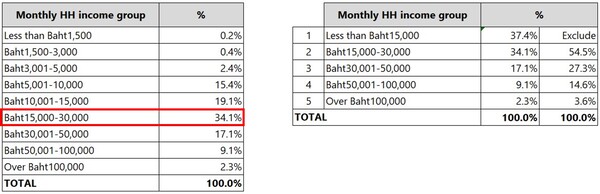
Please see here for detailed data.
3. Thai Consumers' Values: Practicality, Self-Improvement, and Word-of-Mouth
We examine what Thai consumers value and how they spend their money, breaking down their daily spending habits and household budgets.
(1) Experience-Based Consumption and Self-Improvement Driven by a Desire for “Practicality”
In Japan, there has been a shift away from “product-based consumption”—which seeks physical satisfaction—toward “experience-based consumption,” where people prioritize practical value and spend money on experiences. Similarly, in Thailand, approximately 80% of consumers place value on “activities that offer tangible benefits,” indicating a growing preference for experience-based consumption. In particular, they tend to actively spend money on daily necessities that are directly linked to their daily lives.
Furthermore, looking at the values of Generation Z in particular, “self-improvement” is the top priority in their lives. A strong focus on skill development and learning is a defining characteristic of Thailand’s younger generation.
(2) “Online Word-of-Mouth” Is Key to Information Gathering
When purchasing products, consumers actively gather information online, and there is a particularly strong tendency to place importance on online reviews. When making purchasing decisions, evaluations and reviews from actual users serve as crucial reference points.
Please click here for detailed data.
▶Related Reports (Free):A Four-Country Survey on Spending Habits
▶Related Reports (Free):Survey report on GenZ in ASEAN
4. Changing Eating Habits: From “Eating Out” to “Eating at Home” and Beyond
Thailand is known for its deep-rooted food culture, epitomized by street food stalls, but in recent years, dietary habits have become more diverse as lifestyles have changed. Here, we’ll introduce the major food-related trends in Thailand.
(1) Foreign Cuisine Prepared at Home Varies by Socioeconomic Class (SEC)
In Thailand, dietary habits differ depending on socioeconomic class (SEC). In particular, the higher the SEC, the more likely households are to prepare foreign cuisines such as Japanese and Western dishes at home. Additionally, regardless of SEC, many households use microwaves and rice cookers, and cook using multifunctional appliances with additional features.
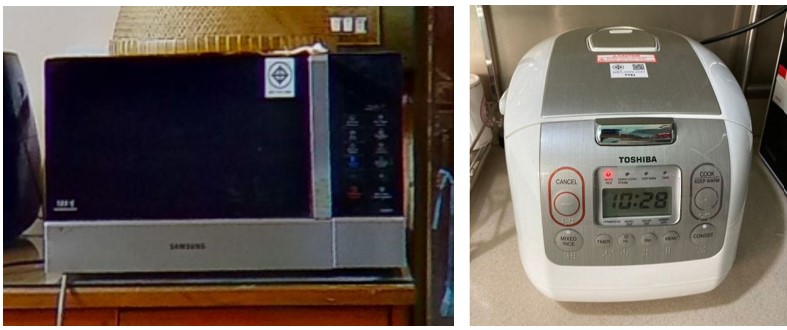
Source: Intage Consumer Life Panorama
For more details, please see this article.
▶Related articles:[Bangkok, Thailand, by SEC (Socio-Economic Class)] Eating Habits
What is Consumer Life Panorama?
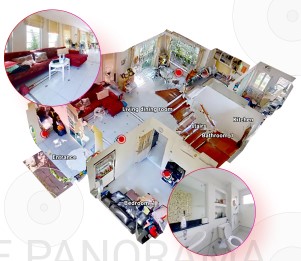
This is a website-type database that has accumulated visual data on more than 1,000 sei-katsu-sha from 18 countries around the world. The database includes many 3D models of living environments and 2D data of items owned by each sei-katsu-sha, and is useful for understanding overseas sei-katsu-sha, which is difficult to grasp using only letters and numbers.
Using visual data such as those cited in this column,
Compare the differences in the attributes of overseas consumers
To get a realistic understanding of the actual usage of each category
To understand the overall lifestyle of target consumers
etc., can be utilized as a “no-go” home visit survey.
(2) The Rise of Home Cooking and Growing Interest in Kitchen Appliances in a Nation Known for Dining Out
While Thailand has traditionally been strongly associated with a culture centered on dining out, epitomized by street food stalls, a trend toward “home cooking”—where people enjoy preparing meals at home while prioritizing healthy eating—has been gaining momentum in recent years due to changing lifestyles. People are becoming more conscious of adopting healthier eating habits, such as actively incorporating vegetables into their diets and reducing fat intake.
This trend is particularly evident among relatively affluent households in Bangkok, and as the demand for home cooking rises, so does the demand for new kitchen appliances. Among these, air fryers and coffee makers appear to be especially popular.
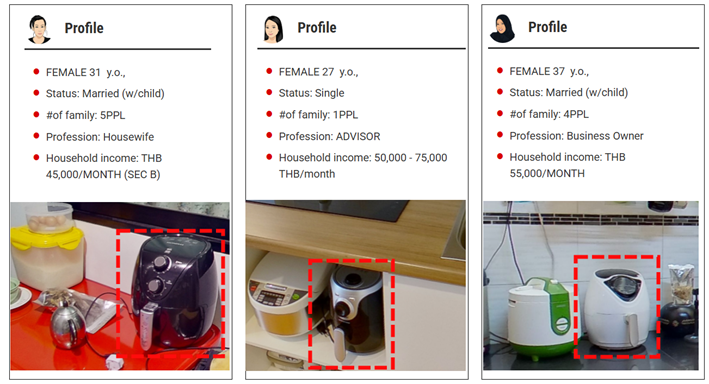
*Photos are excerpted from “Consumer Life Panorama” (commonly known as CLP),
Intage's visual database of people living overseas.
For more details, please see this article.
▶Related articles:The Rise of Home Cooking in Thailand, a Nation of Dining Out──What Kitchen Appliances Are Next in the Thai Market?
▶Related Reports (Free):Eating habit in Thailand
5. Growing Health Awareness and the Rapidly Expanding Supplement Market
In recent years, driven by changes in lifestyle, health awareness among people in Thailand has been growing more than ever before.
(1) The Latest Health Trends and Wellness Demand in Thailand
In Thailand, awareness of daily health maintenance and prevention is on the rise, and this trend can be broadly categorized into “four major trends.”
Trend 1: The Establishment of Preventive Medicine and Daily Health Management
Rather than waiting to treat illness after it occurs, there is a growing awareness of actively maintaining and preventing health issues through daily life.
Trend 2: Emphasis on Mental Wellness and Stress Care
Interest is growing not only in physical health but also in mental health care, such as improving mental well-being and sleep quality.
Trend 3: Personalization and the Adoption of Digital Health
There is a growing movement to use digital tools, such as apps and wearable devices, to manage health in a way that is tailored to individual constitutions and lifestyles.
Trend 4: Natural Lifestyles and Inner Beauty Through Diet
There is a growing awareness of incorporating organic foods and supplements into daily life to promote health and beauty from the inside out through diet.
รีวิว : น้ำมะเขือเทศดอยคำ 99% สูตรโซเดียมต่ำ ผู้ผลิต : บ.ดอยคำ โรงงานหลวงส่วนพระองค์(แม่จัน) ราคา : 17 บาท ...
Nune noppaluckさんの投稿 2016年10月22日土曜日
Doikham, a leading fruit juice manufacturer in Thailand,has launched a reduced-sodium version of its popular tomato juice in response to changing consumer trends.
This growing health consciousness is influencing a wide range of markets, including food, healthcare, fitness, and beauty. In the Thai market, rather than simply emphasizing functionality, keywords such as “prevention,” “wellness,” and “personalization” are likely to be key factors in resonating with consumers.
Click here for more details.
▶Related articles:[Thailand] Thailand Health Trend 2024 (Part 1)
▶Related articles:[Thailand] Thailand Health Trend 2024 (Part 2)
(2) The Rapidly Growing Market for Health Supplements and Dietary Supplements
Driven by growing health consciousness, the market for dietary supplements and health supplements is expanding rapidly in Thailand. Thailand has also emerged as a key market within the ASEAN region as a whole.
Several trends are driving this market expansion.
① Shift from “Treatment” to “Prevention”
Amid rising medical costs and changing lifestyles, the habit of taking supplements to boost immunity and maintain health on a daily basis—rather than waiting to treat illness after it occurs—is becoming widespread.
② Expansion of the Middle Class and an Aging Population
While purchasing power has increased due to economic growth, Thailand is also experiencing a declining birthrate and an aging population. Consequently, spending on anti-aging products and health foods for seniors is on the rise.
③ Diversification of Beauty and Wellness Goals
The role of supplements extends beyond mere nutritional supplementation. There is a growing demand for products tailored to individual consumer concerns, such as improving skin quality, weight management, and enhancing sleep quality.
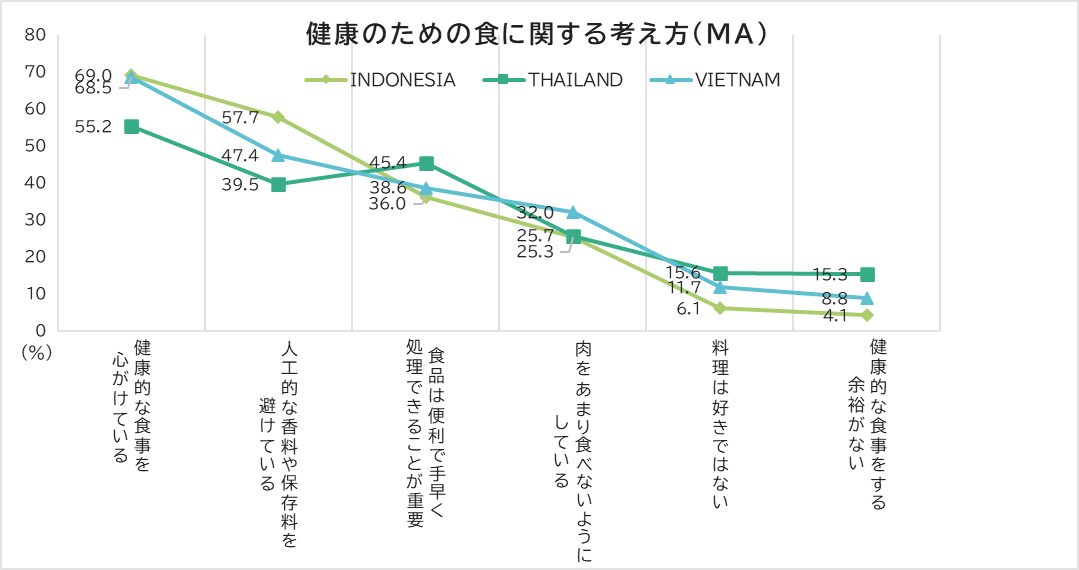
Regarding the statement “It is important for food to be convenient and quick to prepare,”
Thailand scored more than 5 points higher than the other two countries
Figure 1: Attitudes toward food for health (MA)
Source: Intage Global Viewer (2024) V0221
For more details, please click here.
▶Related articles:【ASEAN】Health Supplement Market: Insights from Rapid Growth
▶Related Reports (Free):Thailand's Supplement Market 2023
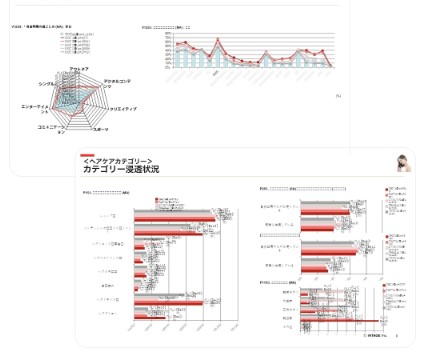
Accelerate decision-making with smart overseas resident data
Global Viewer
This service provides reports tailored to your issues using questionnaire data on various actual conditions and attitudes of sei-katsu-sha in 11 countries (Asia and US) stocked by INTAGE.
The service covers 400 items, including actual behavioral conditions and awareness, values, and information contact related to various product and service categories.
(3) Beverages and Plant-Based Alternative Foods Trends
In Thailand, carbonated beverages are highly popular due to the country’s warm and humid climate, making this a particularly fast-growing category within the beverage market in recent years. Within the carbonated beverage market, new trends reflecting changing consumer preferences are emerging, such as the growth of sugar-free (zero-sugar) and low-sugar beverages, driven by rising health consciousness.
Furthermore, interest in and acceptance of plant-based foods—which are garnering global attention—are relatively high in Thailand. Partly due to the country’s traditional vegetarian culture, such as “Khinn Je,” there is a growing trend toward incorporating plant-based foods for health reasons.
Please click here to view the detailed report.
▶Related Reports (Free):Unveiling Thirst Trends in Thailand's Carbonated Soft Drink Market
▶Related Reports (Free):Global Report on Plant-Based Foods
6. Unique Thai Spending Habits: Lavish Weddings
While Thais tend to prioritize rational spending in their daily lives, they are also known for being willing to spend generously on life events such as weddings and celebrations. Here, we’ll explore this distinctive, balanced approach to spending.
● Lavish Weddings and Asset Building
In Thailand, preparing assets such as a home and gold is considered essential for marriage. In particular, there is a custom where the groom’s family presents a dowry to the bride’s family, with the amount sometimes reaching several million baht (approximately 11 million yen).
Additionally, it is common to receive gold necklaces or bracelets as wedding gifts, reflecting a deeply rooted culture of holding gold as an asset while also wearing it as jewelry.
Thus, in Thailand, there is a tendency to prioritize asset-based products at major life milestones, and in the wedding-related market, products and services that emphasize “asset value” and “gifting” are key factors.
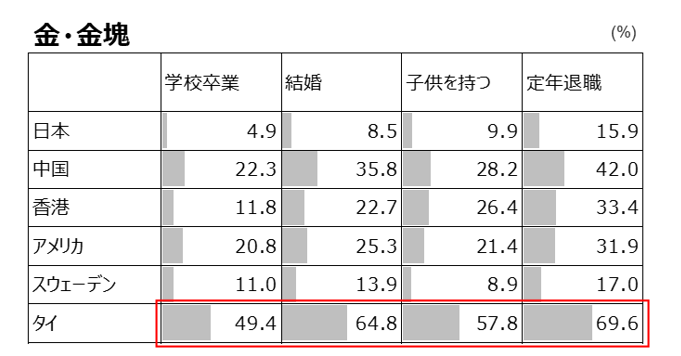
*Gold bars and gold jewelry, such as necklaces and bracelets, are often given as gifts on many occasions, including weddings and the birth of a child.
*(Question) Q7 Please select the items you would like to have for each of the following life stages: (1) When you graduate from school and start working (2) When you get married (3) When you welcome your first child (4) When you reach retirement age
Source:Intage Independent Survey (Report on life event and asset in 9 countries)
URL:https://www.global-market-surfer.com/report/detail/152/
Click here for more details.
▶Related articles:[Global Series: Marriage and Assets] Thailand: Preparing for Marriage

7. Mobility Trends: Government-Led Shift to EVs
Finally, we will discuss the latest trends in infrastructure and mobility, which are closely intertwined with people’s daily lives.
● Thailand’s Car-Centric Society and the Rapid Shift to EVs
Thailand is a mature market with one of the highest vehicle ownership rates in Southeast Asia. It has the highest vehicle ownership rate among ASEAN countries, with approximately 170 million registered passenger vehicles as of 2020.
In recent years, the government has been actively promoting the adoption of EVs, accelerating the shift toward electrification. Through support measures such as tax breaks and subsidies, the Thai government has set a goal of increasing the proportion of EVs in total vehicle production to 30% by 2030. Against the backdrop of these policies, overseas EV manufacturers—led by Chinese companies—are entering the market, accelerating its expansion.

EVs owned by Thai consumers. Left: MG ZS (GWM Group) (TH_159),
Right: Ora Good Cat (SAIC Group) (TH_169)
Source: Consumer Life Panorama
Click here for more details.
8. Conclusion
To effectively approach the Thai market, it is important to first identify the “average profile” that represents the typical consumer, and then gain a multifaceted understanding of the diversity in lifestyles and values.
When analyzing the profile of Thai consumers, utilize data sources such as Global Viewer and Consumer Life Panorama to develop a systematic understanding of demographic trends, consumer behavior, and shifts in values.