目次
1. Introduction
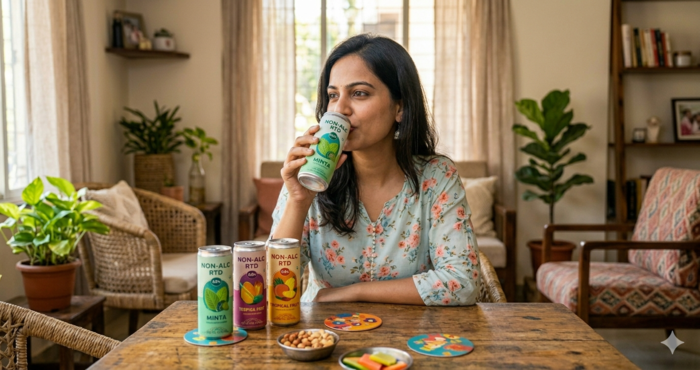
India’s non-alcoholic ready-to-drink (RTD) beverage market is showing signs of growth, driven by the experiential needs of urban 20-somethings—such as “social gatherings,” “dining out,” and “changing up their routine.” In this article, we combine insights from Intage’s “Global Viewer (2025)” international consumer data with local media reports and brand case studies to analyze who drinks these beverages, when they drink them, and why, and to outline key considerations for market entry.
2. The State of Non-Alcoholic RTD Beverages in India: A Data-Driven Analysis
According to Intage’s “Global Viewer” survey (conducted in 2025), which tracks consumer behavior overseas, India has a large estimated population that “drinks some form of non-alcoholic beverage at least once a month” (Figure 1), and there is a high level of preference for non-alcoholic RTDs (such as mocktails) (Figure 2).
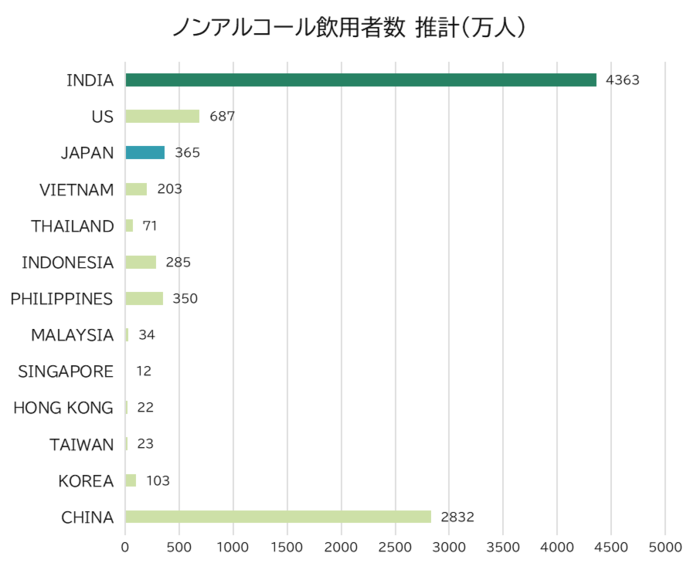
*This estimate is derived by multiplying the percentage—calculated by dividing the number of respondents who reported drinking non-alcoholic beer, non-alcoholic wine, non-alcoholic sparkling wine, or non-alcoholic RTDs (such as non-alcoholic cocktails) at least once a month by the total number of respondents in each country—by the population of each country.
*Since the same penetration rate is applied to the population regardless of whether respondents are from rural or urban areas, this figure is intended solely as a reference for comparison purposes.
Figure 1: Estimated Number of Non-Alcoholic Beverage Consumers
Source: Intage Global Viewer (2025)
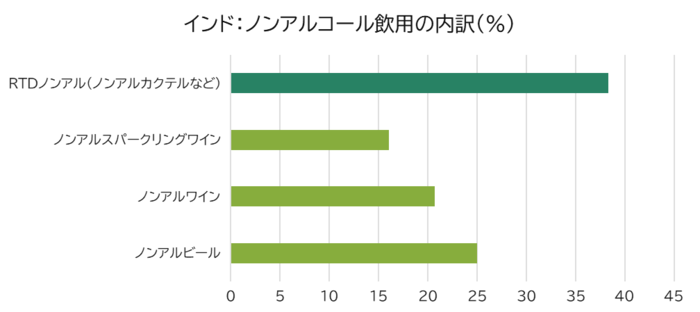
*Breakdown of responses from those who reported drinking some type of non-alcoholic beverage at least once a month in the Intage Global Viewer (2025) survey.
Figure 2: Breakdown of Non-Alcoholic Beverage Consumption in India
Source: Intage Global Viewer (2025)
Accelerate decision-making with smart overseas resident data
Global Viewer
This service provides reports tailored to your issues using questionnaire data on various actual conditions and attitudes of sei-katsu-sha in 11 countries (Asia and US) stocked by INTAGE.
The service covers 400 items, including actual behavioral conditions and awareness, values, and information contact related to various product and service categories.
How is the boom in the non-alcoholic beverage market being reported locally?
According to the Times of India, RTD mocktails and punches made with “natural ingredients (such as fruits, herbs, and spices)” have entered the Indian market. With the rise in house parties in the post-pandemic era, these drinks are reportedly being chosen as “alternatives to cola” and “options that don’t require a bartender.”
Furthermore, the article reports that there are over 200 players in India’s RTD juice, mocktail, and non-alcoholic beverage market. (Source URL: Times of India, May 4, 2024)
Furthermore, according to Fortune India, zero-proof (0%) cocktails in urban restaurants are evolving from being merely “sweet mocktails” to becoming craft beverages featured on menus that incorporate techniques (such as extraction and infusion) and storytelling. (Source URL: Fortune India, November 2, 2025)
Based on this local information, it appears that demand for non-alcoholic RTD beverages is clearly emerging in India.
3. Demand for Non-Alcoholic Beverages in India
So, who is drinking non-alcoholic beverages in India?
According to Intage’s “Global Viewer” survey (conducted in 2025), which tracks consumer behavior overseas, the largest segment of users who consume these beverages at least once a month consists of men and women in their 20s living in urban areas (Figures 3 and 4).
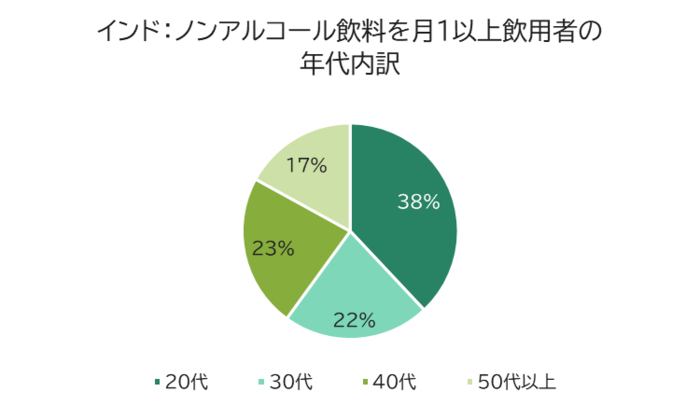
*Age breakdown of respondents who reported drinking some type of non-alcoholic beverage at least once a month in the Intage Global Viewer (2025) survey.
Figure 3: Breakdown by age group of those who consume non-alcoholic beverages
at least once a month in India
Source: Intage Global Viewer (2025)
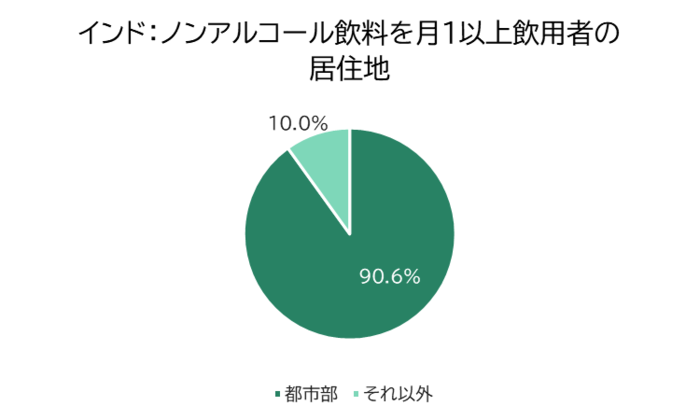
*Breakdown by place of residence of respondents who reported drinking some type of non-alcoholic beverage at least once a month in the Intage Global Viewer (2025) survey.
Figure 4: Residential Areas of Individuals in India Who Consume Non-Alcoholic Beverages
at Least Once a Month
Source: Intage Global Viewer (2025)
Let’s examine the daily scenarios in which men and women in their 20s living in urban areas seek non-alcoholic beverages by analyzing the marketing messages of Indian non-alcoholic brands.
Swizzle, an Indian mocktail brand, prominently features “100% natural,” “vegan,” and “no chemical additives” on its official website (Source URL: Swizzle Official). Additionally, according to ET HospitalityWorld (The Economic Times’ hospitality media outlet), the brand has reportedly announced plans to expand into quick commerce, mass retail, vending machines, and HoReCa (Hotel + Restaurant + Café / Catering) (Source URL: ET Hospitality, December 17, 2025).
From this, one can imagine a scenario where urban 20-somethings “choose low-guilt carbonated mocktails nearby on their way home from work or before weekend gatherings.”
On the other hand, in the context of “celebratory occasions,” another Indian RTD mocktail brand, PEEYO, is seen promoting experiences for party-loving young people with slogans like “Think Party? Drink PEEYO” and “Embrace the buzz” (Source URL: PEEYO Official). This suggests a use case where non-alcoholic drinks are used to create a “festive look” and “party atmosphere” during gatherings with friends.
4. Summary
When we overlay Intage’s “Global Viewer” data on overseas consumers (collected in 2025) with local media reports and brand case studies, it appears likely that demand for non-alcoholic RTD beverages in India will grow not so much as an “alternative to alcohol,” but rather as “valuable soft drinks” linked to the experiences of urban 20-somethings.
When considering market entry, the following three points are likely key:
(1) Design the drinking experience not merely as “alcohol-free cocktails,” but by incorporating “aromas, herbs, and spices” as well.
(2) Integrate urban lifestyle trends—such as on-demand delivery, small-sized portions, and bulk/assortment purchases—from the outset.
(3) Create experiences through dining out and events, and extend them to the home (zero-proof = emphasis on experiential value).
In particular, unlike the image of non-alcoholic beverages in Japan—which are seen as “substitutes for when one cannot drink” or “replicas of the taste of real alcohol”—it seems necessary to pay attention to the unique experiential value that non-alcoholic RTDs possess in India.