目次
- 1. Introduction
- 2. Do young men and women in China place a high priority on their hair when it comes to their appearance?
- 3. Concerns about appearance: Common concerns for both men and women—“sebum and greasiness”
- 4. Refining Hair Care Routines Through the Lens of the Gender Gap
- 5. Digital Decision-Making Processes: Where to Choose and Where to Buy
- 6. Summary
1. Introduction
In recent years, the so-called “face economy” has been expanding rapidly in China’s consumer market, and self-investment in appearance is becoming increasingly specialized and sophisticated, extending beyond skincare into the hair care sector.
Particularly among young people in their 20s and 30s, the use of image- and video-centric recommendation-based social media platforms such as Xiaohongshu (RED) and Douyin (the Chinese version of TikTok) has become commonplace. On these platforms, users make quick judgments about content, so visual impressions have a significant impact on capturing initial attention. As a result, interest in factors that shape first impressions has grown, and “hair condition” in particular is increasingly viewed as a key element that determines one’s overall appearance.
In this article, based on Intage’s “Global Viewer” data on overseas consumers (2025), we will compare the hair care attitudes and behaviors of young male and female consumers in their 20s and 30s within the Chinese market.
2. Do young men and women in China place a high priority on their hair when it comes to their appearance?
What do young Chinese men and women in their 20s and 30s think about their hair? To explore this, we examined the importance placed on physical appearance using Intage’s “Global Viewer” data (collected in 2025), which tracks consumers overseas.
The results show that “cleanliness” ranked first, while “hair” was considered the second most important factor by many respondents, alongside “body and overall impression” and “skin.” This indicates that hair is viewed as one of the key elements of one’s appearance.
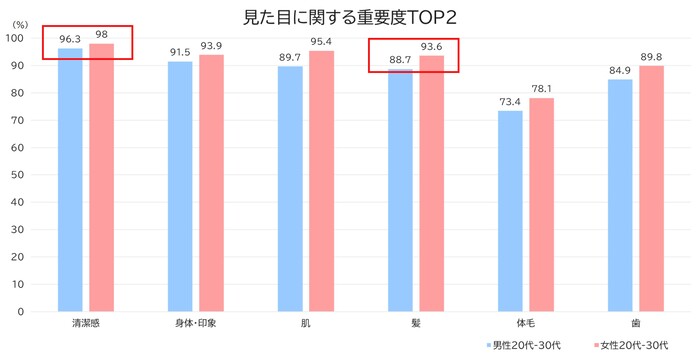
Figure 1: Importance of Appearance (multiple selections allowed) – Top responses from
men and women (Base: Chinese men and women in their 20s and 30s)
Source: Intage Global Viewer (2025)
Accelerate decision-making with smart overseas resident data
Global Viewer
This service provides reports tailored to your issues using questionnaire data on various actual conditions and attitudes of sei-katsu-sha in 11 countries (Asia and US) stocked by INTAGE.
The service covers 400 items, including actual behavioral conditions and awareness, values, and information contact related to various product and service categories.
3. Concerns about appearance: Common concerns for both men and women—“sebum and greasiness”
So, when it comes to “hair”—a key component of one’s appearance—what concerns do young Chinese men and women in their 20s and 30s have? According to the data, “oily or greasy scalp” was the most common concern for both men and women, affecting 42.5% of men and 46.5% of women.
On the other hand, distinct patterns emerged by gender. For example, men were notably concerned with issues stemming from excessive sebum production, such as dandruff (33.7%) and itchy scalp (20.8%). Women, in addition to “future concerns” like lack of hair volume (33.8%) and hair loss (33.5%), were also sensitive to dry hair (27.4%).
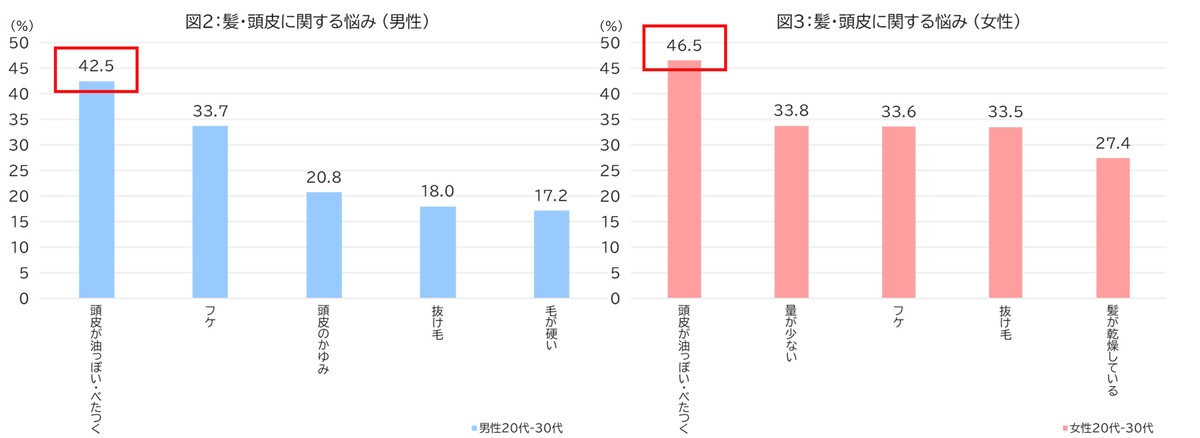
Figures 2 and 3: (MA) Top 5 Concerns Regarding Hair and Scalp
(Base: Chinese men and women in their 20s and 30s)
Source: Intage Global Viewer (2025)
4. Refining Hair Care Routines Through the Lens of the Gender Gap
When it comes to addressing these concerns, a gender gap is evident in the approaches taken by young people. While shampoo use is widespread among all users, differences emerge in the subsequent steps of their hair care routines. Regarding the quality of hair care, the usage rate of conditioners and hair treatments reaches 74.4% among women, whereas it stands at a mere 28.8% among men. This highlights the current reality that many men still limit their hair care to simply “washing their hair.” Furthermore, regarding investment in styling, women use hair dryers (75.0%) and hair straighteners (32.3%), focusing not only on hair texture but also on creating a specific “vibe.”
As for the potential market, while anxiety about hair loss is high, the usage rate of hair growth products and hair tonics is low at around 10% for both men and women, making this a “blue ocean” with room for future growth.
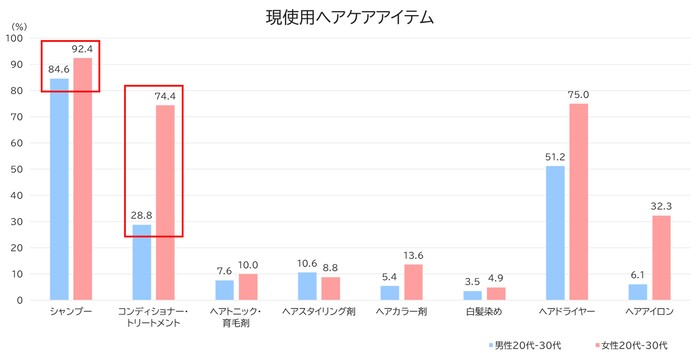
Figure 4: (MA) Currently Used Hair Care Products (Base: Chinese men and women in their 20s and 30s)
Source: Intage Global Viewer (2025)
5. Digital Decision-Making Processes: Where to Choose and Where to Buy
Young people in their 20s and 30s in China—the “digital native” generation—exhibit an extremely high level of reliance on online channels in the hair care market. According to data, the concentration of female consumers on specific channels is particularly striking, with 44.7% of shampoo purchases made on e-commerce platforms, far outpacing other channels. This indicates that women’s purchasing behavior is strongly “online-driven.”
On the other hand, male consumers’ purchasing process tends to be more “omnichannel.” While online remains the primary channel, the purchase rates for shampoo at department stores (21.0%) and supermarkets (10.2%) are significantly higher for men than for women. These results suggest that while men prioritize convenience, they maintain offline purchasing habits such as “immediate purchases” when needed and “purposeful product selection” at high-end counters in department stores.
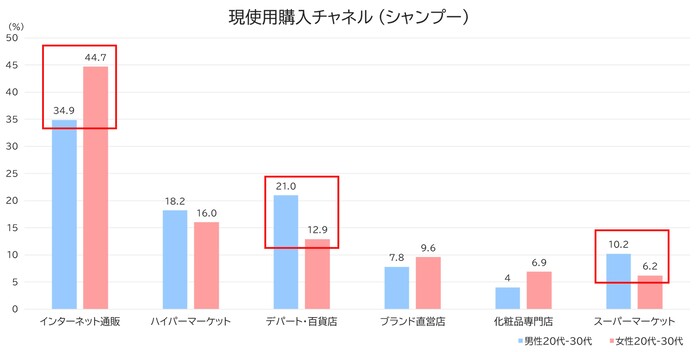
Figure 5: (SA) Top 6 purchase channels for currently used shampoos
(Base: Chinese men and women in their 20s and 30s)
Source: Intage Global Viewer (2025)
6. Summary
The data reveals that among young adults in their 20s and 30s in China, hair care is considered a key component of personal grooming. In particular, “oily or sticky scalp” is the top concern for both men and women, indicating a strong emphasis on maintaining a clean appearance.
On the other hand, differences in hair care behaviors are evident between men and women. While women tend to follow a multi-step routine and place importance on overall appearance, including styling, men generally stick to a simple, shampoo-centric regimen. Differences in purchasing behavior were also observed: women primarily shop online via e-commerce platforms, whereas men tend to use a combination of online and offline channels.
Based on these results, the hair care market for young people in China is expected to see growing demand for scalp care products that address the shared concerns of both men and women regarding sebum and stickiness. Furthermore, it is considered effective to propose products that prioritize convenience for men and to develop segmented products tailored to specific concerns and functions for women.
Furthermore, given the low usage rate of related products despite concerns about hair loss, the hair growth and scalp care market is attracting attention as a future growth area. Taking into account differences in purchasing behavior and incorporating channel strategies, the hair care market for young people in China is expected to continue expanding.