目次
- 1. Introduction
- 2. A Peek into Real-Life Mealtimes! “Food Diaries” from Four Major Cities
- 3. Five Meals a Day? Japan’s Unique “Frequent Eating Culture” and the Rise of Dining Out and Food Delivery
- 4. From Masala to Protein? Rapidly Growing Health Awareness
- 5. Foreign Cuisines That Have Become Part of Everyday Life and the Unique Position of “Japanese Cuisine”
- 6. [Beverage Trends] Clear Distinctions in Consumption and Growing Demand for “Sugar-Free and Healthy” Options
- 7. Summary
1. Introduction
When people hear “Indian food,” many probably picture “spicy curry every day.” However, in recent years, the eating habits of young people in India—especially in urban areas (Generation Z and Millennials)—have become far more diverse than we might imagine. Driven by the rise in dual-income households as more women enter the workforce, as well as delivery habits that have become firmly established in the wake of the COVID-19 pandemic, foreign cuisines and RTC/RTE (ready-to-cook and ready-to-eat) foods have become deeply integrated into daily life, even as traditional cuisine remains the foundation.
In this article, based on qualitative research conducted with 16 young people living in the four major cities of Delhi, Mumbai, Bangalore, and Kolkata, I would like to introduce business opportunities revealed by real-life dining habits and the latest beverage trends.
2. A Peek into Real-Life Mealtimes! “Food Diaries” from Four Major Cities
It is difficult to view all of India as a single market. This is because the country is so diverse from region to region that it is often said, “Dialects change every 15 miles, and the flavor of curry changes every 25 miles.” In fact, when you look at the “weekly food diaries” of young people in the four major cities, these differences become strikingly apparent.
[Examples of City-by-City Food Diaries]
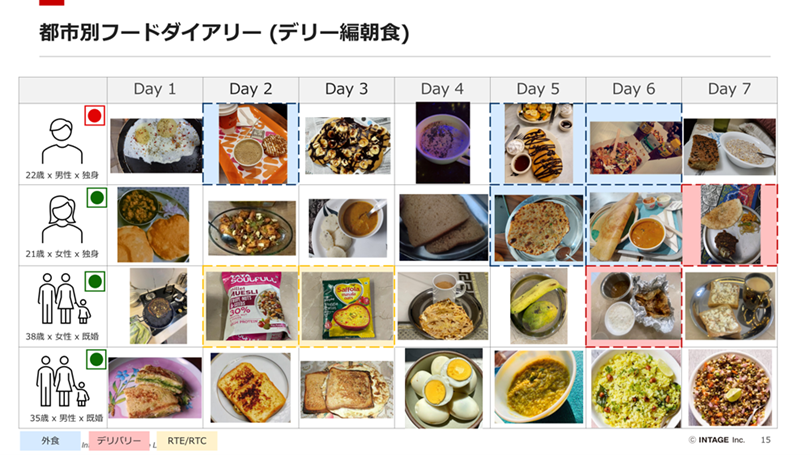
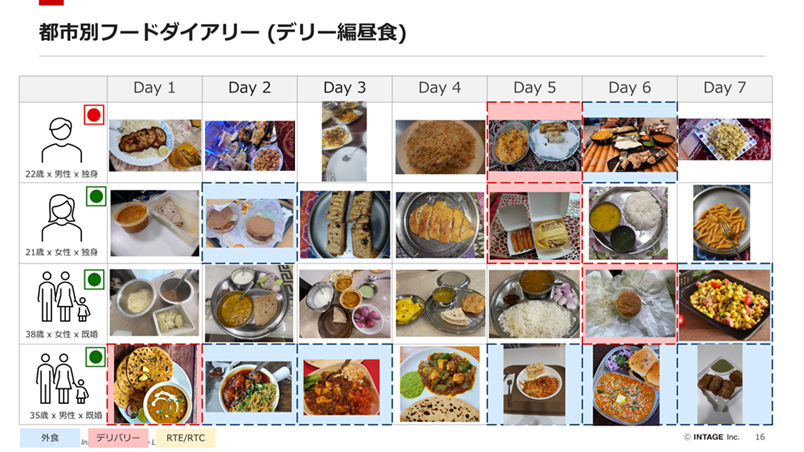
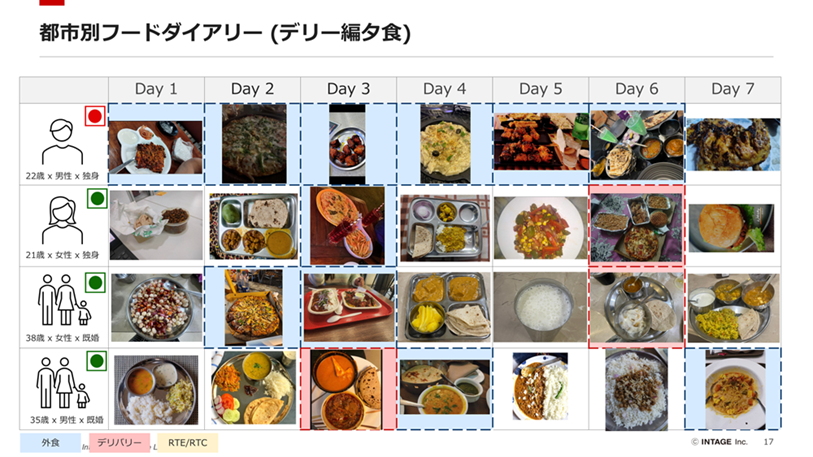
●: Non-vegetarian ●: Vegetarian
*If you're interested in food diaries from other cities, please also check out the report here.
[Report] Five Meals a Day, the Protein Boom, and the Popularity of Japanese Food: Three Current Trends in the Indian Food Market and Exploring Business Opportunities
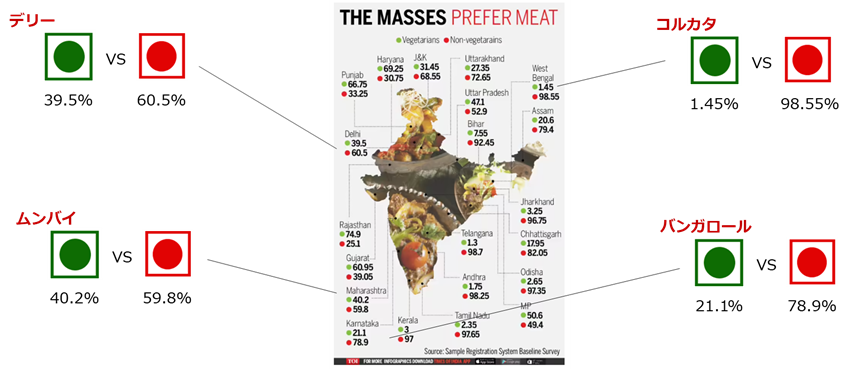
For example, there are significant regional differences in the ratio of vegetarians to non-vegetarians. While the proportion of vegetarians in India as a whole is said to be about 30%, in Kolkata in the east, only 1.45% of the population is vegetarian, while 98.55% are non-vegetarians, and a diet centered on fish curry and meat dishes is the norm. In contrast, in Mumbai in the west, vegetarians account for 40.2% of the population—a relatively high proportion—largely due to the large number of residents originally from the predominantly vegetarian state of Gujarat.
In terms of staple foods, while the diet in northern cities like Delhi and Mumbai centers on a combination of “roti” (flatbread), “subzi” (stir-fried vegetables), and “dal” (lentil curry), in the southern city of Bangalore, “rice” serves as the base, and easily digestible dishes such as idli and dosa (made from fermented rice or lentil batter) are preferred. When considering market entry into India or product development, it is essential to accurately understand these “fundamental differences in food culture” between cities.
[Map of the Ratio of Vegetarian to Non-Vegetarian Populations by City]
To Understand Markets That Can’t Be Seen Through Publicly Available Information Alone
Intage’s Overseas Research
“No matter how much more I research, I can’t find the information I need.”
In such cases, we recommend Intage’s overseas research services.
Leveraging our in-house offices in 9 countries, a network spanning over 60 countries, and a track record of more than 500 completed studies,
we can help you understand the true sentiments of local consumers and the realities of the market.
In addition, we support a wide range of methods—from quantitative and qualitative research to social media analysis—to assist you in gathering the information necessary for your global strategy.

3. Five Meals a Day? Japan’s Unique “Frequent Eating Culture” and the Rise of Dining Out and Food Delivery
One of the major characteristics of the Indian diet is “frequent eating.” It is common to eat 3 to 5 meals a day, with “snack times” in between breakfast, lunch, and dinner. While guilt-free options like fruit and nuts are preferred in the morning, the “evening snack” between 5:00 p.m. and 7:00 p.m. has become an indispensable part of people’s lives as a time to satisfy their cravings. Large crowds gather at street food stalls to enjoy samosas, chaat, and junk food on a daily basis. Because of this evening snack, dinner—the last meal of the day—is eaten late, between 9:00 p.m. and 11:00 p.m., and often consists of heartier dishes such as butter chicken or biryani.
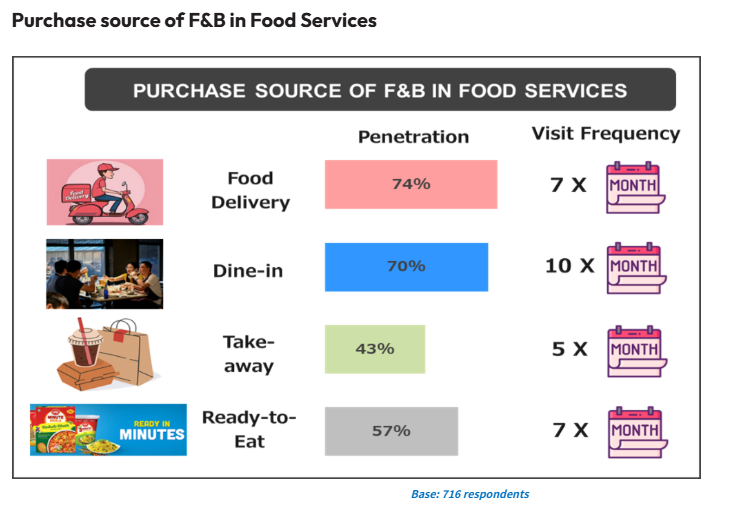
Meal preparation habits are also changing. While “home-cooked meals” remain the foundation, accounting for about 50% of meals, reliance on external services is increasing, with “prepared meals (delivery, takeout, etc.)” making up 30% and “eating out” 20%.
For busy weekday lunches, they prioritize value for money by keeping costs to around 100–250 rupees (approx. 170–420 yen) per day at cafeterias near the office; on weekends, however, they are willing to spend 500–2,000 rupees (approx. 850–3,400 yen) or more on multinational cuisine at restaurants as a leisure activity. This balanced approach to spending is becoming the norm among today’s young people.
4. From Masala to Protein? Rapidly Growing Health Awareness
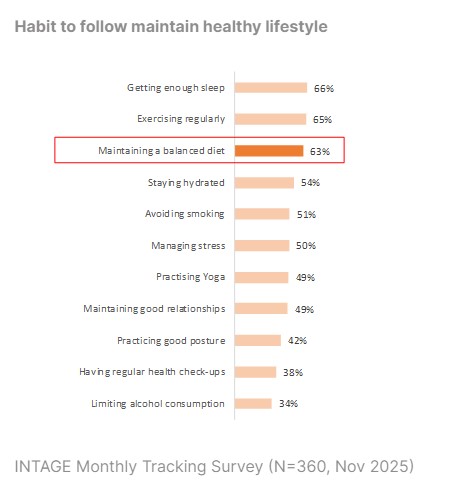
While people lead increasingly busy lifestyles, health awareness is rapidly growing, driven in part by the rise in lifestyle-related diseases. In India, where there is a large vegetarian population, “protein deficiency” has been a long-standing issue. However, in recent years, demand for foods marketed as “High Protein” has surged.
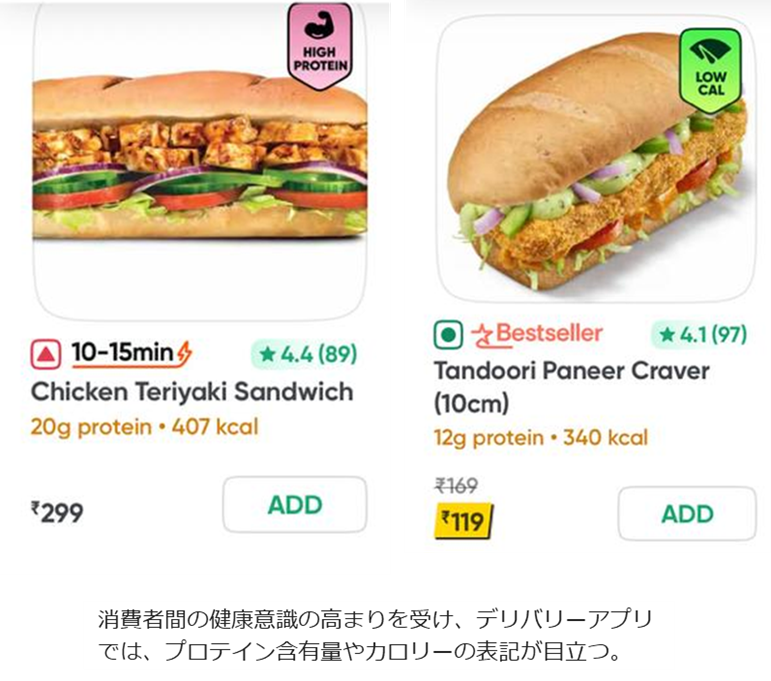
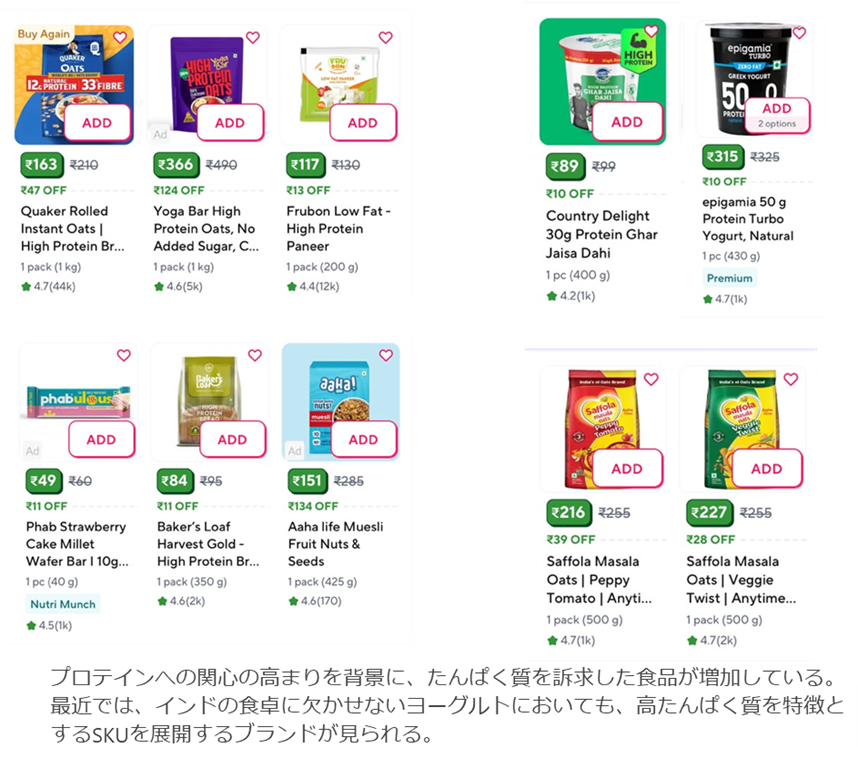
When you open delivery apps like Zomato or Swiggy, you’ll see protein content and calorie counts prominently displayed on menus. Even for items like dahi (yogurt) and oats—which are staples on Indian dining tables—brands offering high-protein SKUs* are gaining prominence. Driven by a sense of guilt over traditional meals that use large amounts of oil and spices, a growing number of consumers are consciously prioritizing “health” in their daily lives and placing greater importance on the nutritional value of ingredients.
*SKU: Stock Keeping Unit—the “smallest unit of inventory” for a product
[Calorie and Protein Labeling on Delivery Apps]
5. Foreign Cuisines That Have Become Part of Everyday Life and the Unique Position of “Japanese Cuisine”
The rise of dining out and food delivery is further accelerating the acceptance of global flavors. In the past, when people thought of foreign cuisine, the mainstream options were “Indian-Chinese” dishes (such as momo and chow mein)—which were uniquely adapted with oil and spices—and “pizza and burgers.” However, driven by the influence of social media and K-POP, “Korean cuisine” is now experiencing explosive popularity among young people. Spicy noodle dishes, in particular, are highly compatible with Indian palates, and major manufacturers such as Maggi have been launching Korean-flavored instant noodles one after another, making them a staple.
On the other hand, “Japanese cuisine” has established a very unique position. Rather than being an everyday, mass-market meal like “Indian-style Chinese,” it is recognized as a “special meal for the upper classes—healthy, easy on the stomach, and visually appealing enough to look good on social media.” In recent years, it has become a huge trend among the wealthy and celebrities, and there are increasing instances of prominent figures—such as renowned film producer Karan Johar and Gauri Khan, wife of a major movie star—personally producing Japanese restaurants (such as Oju and Torii). I feel that Japanese cuisine has tremendous potential as a “treat experience” worth trying, even at a high price.
[Japanese Restaurants Produced by Celebrities and Social Media Posts]
Oju, produced by Karan Johar. It has stores in Mumbai and Gurugram.
Torii, produced by Gauri Khan. It has a store in Mumbai.
Mizu, a Japanese restaurant in Mumbai, is the most famous restaurant among celebrities.
6. [Beverage Trends] Clear Distinctions in Consumption and Growing Demand for “Sugar-Free and Healthy” Options
Finally, I would like to touch on the “beverage market,” where business opportunities are expanding alongside the food sector.
Indians clearly distinguish between beverages based on the time of day and their intended purpose. In addition to chai—a national beverage consumed multiple times a day for refreshment—fruit juices, coconut water, and buttermilk are widely enjoyed on hot days or when feeling unwell, primarily for nutritional purposes.
What is noteworthy here is that “health consciousness” is driving trends even in the ready-to-drink (RTD) market for bottled beverages such as water and carbonated drinks. Due to the high number of people with diabetes in India, there is extreme concern about “sugar,” and a trend is emerging to cut back on the sugar-laden fruit juices and carbonated drinks that were traditionally mainstream. In recent years, there has been an increase in juices that prominently feature “No added sugar” or “Zero sugar” on their packaging.
Furthermore, awareness of “green tea” as a healthy beverage is growing, and many products are being sold with packaging that highlights weight loss benefits (such as burning belly fat) and other health effects. A particularly growing trend in the Indian market is the prevalence of products that are not just plain green tea, but rather feature added flavors such as lemon, honey, or mint (Tulsi) to make them more palatable. A segment of consumers is also emerging who, for health management purposes, replace a few of their daily cups of chai with green tea.
Furthermore, in addition to foreign chains like Starbucks, local premium café chains offering authentic coffee—such as Third Wave Coffee and Blue Tokai Coffee—are entering the market one after another. Although prices are on the high side at around 250 rupees (approximately 420 yen) per cup, these cafés are evolving beyond mere places of relaxation to become venues for socializing and new experiences among young people.
7. Summary
The dining habits of young people in India are rapidly evolving as they flexibly embrace new values—such as “convenience,” “health” (high-protein, sugar-free), and “new taste experiences” (multinational cuisine)—while still cherishing “tradition.”
The key to capturing the massive Indian market will likely lie in our ability to provide products and services that align with their new lifestyles, while also understanding the profound regional differences in food culture.
At Intage India, we gather authentic local insights on a daily basis through qualitative research utilizing “food diaries” such as those introduced in this article, as well as through “Consumer Life Panorama,” an overseas consumer visual database that allows us to observe consumers’ home environments. If you are interested in exploring business opportunities in the Indian market or gaining a deeper understanding of consumers there, please feel free to contact us.