Commentary
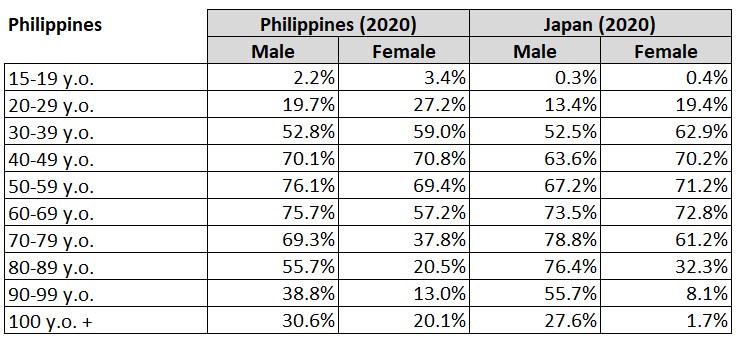
In the Philippines, as in Japan, the married rates of both men and women exceed 50% at 30s.
The married rates of people in their 20s are slightly higher than in Japan, with 19.7% for men and 27.2% for women.
---
This report focuses on “marriage”—a major turning point in life that significantly alters consumer behavior—and explores the cultures and customs deeply rooted in various Asian countries.
How does consumer behavior change as people transition from single life to marriage and parenthood? By analyzing the significant event of marriage, we offer insights that will help you gain a more comprehensive understanding of Asian consumers.
How Do “Marriages” Differ Across Asian Countries!? And the Consumption Behaviors That Come With Marriage ~ Bride Price? Groom Price? What About the Funds? ~
・How are “weddings” conducted in various Asian countries?
・Consumption Patterns Related to Marriage: Preparations and Purchases Made Upon Getting Married
etc.
Reference
* exl. Taiwan
United Nations, Statistics Division. "Population by marital status, age, sex and urban/rural residence".
Retrieved June 23 2020 from https://bit.ly/3dvz2Ky
* Taiwan
Taiwan Dept. of Household Registration Affairs, MOI., Accounting and Statistics "Statistical Yearbook of Interior"
Retrieved June 23, 2020, from https://bit.ly/2Z5elQq
Commentary
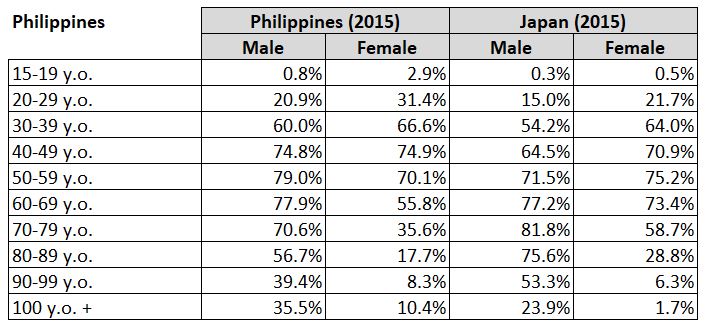
In the Philippines, as in Japan, the married rates of both men and women exceed 50% at 30s. The married rates of people in their 20s are slightly higher than in Japan, with 20.9% for men and 31.4% for women.
Reference
* exl. Taiwan United Nations, Statistics Division. "Population by marital status, age, sex and urban/rural residence". Retrieved June 23 2020 from https://bit.ly/3dvz2Ky * Taiwan Taiwan Dept. of Household Registration Affairs, MOI., Accounting and Statistics "Statistical Yearbook of Interior" Retrieved June 23, 2020, from https://bit.ly/2Z5elQq