目次
1. Introduction
In recent years, the electric vehicle (EV) market in Southeast Asia has shown high growth rates and is attracting attention as a promising market. However, when viewed by country, progress varies significantly; while some markets exhibit relatively high preference for EVs, others still show relatively low preference.
In this article, we will examine the state of the EV market in Southeast Asian countries (Malaysia, the Philippines, Indonesia, Thailand, and Vietnam) based on Intage’s “Global Viewer” international consumer data (collected in 2025).
2. Intentions to purchase EVs vary significantly by country
A comparison of future purchase intentions for different engine types by country, based on Intage’s “Global Viewer” data (collected in 2025), revealed significant regional variations in the intention to purchase EVs.
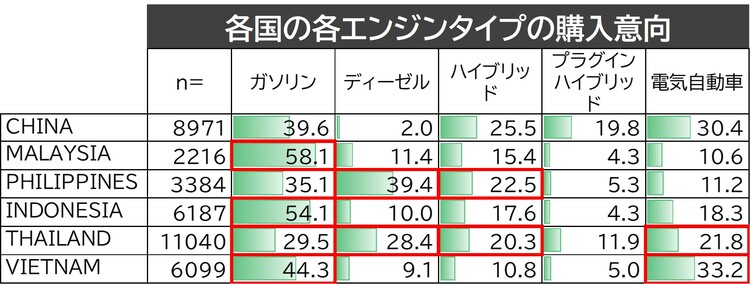
Figure 1: Purchase Intentions for Each Engine Type by Country (Selected items)
Source: Intage Global Viewer (2025)
Accelerate decision-making with smart overseas resident data
Global Viewer
This service provides reports tailored to your issues using questionnaire data on various actual conditions and attitudes of sei-katsu-sha in 11 countries (Asia and US) stocked by INTAGE.
The service covers 400 items, including actual behavioral conditions and awareness, values, and information contact related to various product and service categories.
If we consider China to be a mature EV market, the EV markets in Southeast Asian countries can be broadly categorized into three phases.
First, Vietnam is positioned in the “EV Growth Acceleration Phase.”
Bolstered by the presence of its domestic manufacturer, Vinfast, it is evident that while the intention to purchase EVs still lags behind that for gasoline vehicles, it remains at a high level compared to other countries, including China. It can be said that Vietnam is the market within ASEAN where the shift to EVs is progressing the most.
Next, Thailand and Indonesia are classified as being in the “EV Transition Phase.”
While purchase intent for EVs is not particularly high, it has reached a level comparable to that for hybrid vehicles, and it is evident that the shift toward EVs is progressing at a pace that is catching up to China.
Finally, Malaysia and the Philippines are classified as being in the “early stages of EV adoption.”
In both countries, support for internal combustion engine vehicles (gasoline and diesel) and hybrid vehicles remains strong, and it is evident that the intention to purchase EVs is limited.
3. Attitudes Toward Cars
While Southeast Asian countries are aiming to become hubs for the EV industry and their governments are rolling out measures to foster the sector and promote EV adoption, why do we see such varying levels of consumer interest in purchasing EVs? The answer appears to lie in the differences in consumers’ “values regarding cars” across these nations.
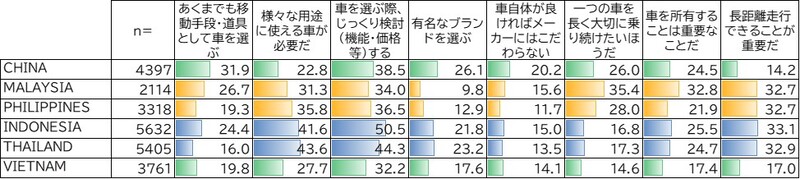
Figure 2: Values regarding cars in various countries (partial list of items)
Source: Intage Global Viewer (2025)
Common values shared by Southeast Asian countries regarding cars include “carefully considering the choice of vehicle,” “prioritizing long-distance driving capability,” and “selecting a vehicle suitable for various purposes.”
First, the emphasis on “carefully considering the choice of vehicle” stems from the fact that cars are high-cost durable goods in household budgets and are used for a long time after purchase. In Southeast Asia in particular, replacement cycles tend to be longer compared to Europe, the United States, and some other developed nations, and there is a strong desire to “avoid making a mistake.” Consequently, consumers tend to make comprehensive comparisons not only of price but also of durability, fuel efficiency, ease of repair, and resale value.
Furthermore, the emphasis on “long-distance capability” and “versatility” stems from the characteristics of the region’s transportation infrastructure and lifestyles. In Southeast Asia, travel between cities and the tradition of returning to one’s hometown for holidays are common, and many countries involve daily long-distance travel. Furthermore, as public transportation is often insufficiently developed in many regions, cars are expected to provide “reliable transportation to any destination.” Consequently, multipurpose vehicles such as SUVs and MPVs are popular in Southeast Asia.
4. Roles and Priorities for Cars
On the other hand, there are differences from country to country in the roles people expect cars to fulfill and the features they prioritize, and this is believed to be contributing to the varying levels of EV acceptance.

Figure 3: Factors Considered When Purchasing a Car in Various Countries
Source: Intage Global Viewer (2025)
Let’s examine the characteristics of each country, using Malaysia and the Philippines—which are classified as being in the “early stages of EV adoption”—and Indonesia and Thailand—which are classified as being in the “transition phase to EVs”—as examples.
Malaysia: A Cautious Market Prioritizing Reliability and Durability
In Malaysia, there is a strong tendency to view cars as practical assets, driven by values such as “car ownership is important,” “I want to keep driving the same car for a long time,” and “I choose a car strictly as a means of transportation or a tool.”
Furthermore, the top priorities when selecting a car are “durability,” “good fuel economy,” and “vehicle price.” In other words, this is a market where factors such as “whether the car can be used safely for a long time,” “whether maintenance costs are low,” and “whether it offers good value for the price” are prioritized over “newness” or “cutting-edge technology.”
Consequently, consumers tend to be cautious about EVs—a new technology where uncertainties remain regarding battery life, resale value, charging infrastructure, and driving range. This likely explains why they prefer proven gasoline and hybrid vehicles over EVs, which involve many unknowns.
In addition, Malaysia is home to domestic manufacturers Perodua and Proton. Both companies hold a significant share of the domestic market, and with their strengths in price competitiveness and ease of maintenance, they are believed to have a major influence on engine type preferences in Malaysia.
Philippines: A Practical Market Prioritizing Versatility
In the Philippines, there is a strong perception that “a car must be usable for various purposes,” and there is a tendency to view cars as tools for family use and daily life infrastructure.
Furthermore, key considerations when choosing a vehicle include “durability,” “performance under adverse conditions,” “interior space,” and “the ability to comfortably seat multiple people,” indicating a strong preference for vehicles that accommodate large groups, serve multiple purposes, and handle rough roads.
In the Philippines, due to road infrastructure conditions in rural areas, environmental factors such as flooding, and the cultural practice of traveling with family and relatives, “reliability in any environment” is considered a top priority.
Consequently, EVs—which still face concerns regarding insufficient charging infrastructure and their ability to handle rough roads and flooded conditions—are currently viewed as difficult to envision as a practical part of daily life.
Indonesia: A Transition Market Where Practicality and Innovation Coexist
In Indonesia, while “cars that can be used for various purposes” are valued, there is also a strong tendency to “choose well-known brands,” resulting in a coexistence of practicality and brand preference.
Furthermore, key considerations when choosing a car include “durability,” “fuel efficiency,” “vehicle price,” and “driving stability.” While the cost of the vehicle is a priority, there is also a strong demand for family-oriented use and comfort; overall, it can be said that this is a market seeking “cars with good value for money.”
While these needs appear to align well with EVs, which offer low running costs, in Indonesia, a single car is often shared by the family and used for a wide range of purposes, such as commuting, school runs, shopping, and visiting relatives, so the need for “long-distance driving” remains strong. Consequently, it is believed that EVs are expected to offer not only cost savings but also a sense of practical reliability. However, since concerns about EV range persist, Indonesia is considered a market where, despite high interest in EVs, consumers are still at the stage of “choosing them if they meet practical needs.”
Thailand: An EV-Friendly Market Prioritizing Innovation and Brand Image
In Thailand, there is a strong tendency to “choose well-known brands,” and in addition to practicality, brand image and a perception of technological advancement are also highly valued.
Furthermore, interest in “cabin quietness” and “engine type” is higher than in other countries, reflecting a focus on comfort and the driving experience. This suggests a high affinity for EVs, which excel in quietness and acceleration performance.
Additionally, due to the development of its automotive industry, Thailand has a relatively high level of acceptance for new technologies. With a diverse range of models being introduced, particularly by Chinese EV manufacturers, the market is well-positioned to accept EVs not only as “environmentally friendly vehicles” but also as “attractive new options.”
It is worth noting that the tendency to “choose well-known brands” is relatively strong in both Indonesia and Thailand. In fact, Toyota and Honda hold high market shares in these countries, suggesting that many consumers recognize both companies as “well-known brands.”
On the other hand, in the Southeast Asian market, both companies currently focus primarily on hybrid vehicles, and their EV lineups are limited. Consequently, for consumers who want to “choose an EV from a trusted brand,” the available options may still be insufficient.
Given these factors, while interest in EVs is growing in Indonesia and Thailand, the limited full-scale EV rollouts by major brands that consumers trust may be one reason why EV adoption remains at a certain level.
5. Summary
In Southeast Asia, while governments are promoting the adoption of EVs, we have found that the values consumers seek in a car vary from country to country.
While “durability, practicality, and peace of mind” are prioritized in Malaysia and the Philippines, “brand image, comfort, and advanced technology” are driving EV adoption in Thailand. Indonesia can be described as a transitional market that falls somewhere in between.
In other words, the widespread adoption of EVs in Southeast Asia depends not only on policies and infrastructure but also on “how well EVs align with each country’s values regarding automobiles.”