目次
- 1. Introduction
- 2. Eating together is the norm: How a culture of sharing shapes food consumption
- 3. Alone or with others? Consumption based on “relationship assumptions” as reflected in dining out
- 4. “Don’t Buy Just for Yourself”: “Sharing” Consumption Rooted in Daily Life
- 5. It’s not just a “private family space.” It’s a home designed with the expectation of welcoming guests.
- 6. Family Gatherings and Ethnic and Religious Events
- 7. Summary
1. Introduction
When discussing the national character of Indonesia, one cannot overlook the value placed on “harmony.” Indonesia is a multi-ethnic and multi-religious nation. Culture, language, and religious beliefs vary from region to region, and people with diverse values coexist.
Within such a society, people have lived their lives while maintaining harmonious relationships with those around them. This is precisely why Indonesians are often described as “calm,” “kind,” and “friendly.”
The term that symbolizes this value is “Gotong Royong.”
Meaning “mutual aid” or “mutual support,” it represents a distinctly Indonesian way of life that values relationships with family, friends, neighbors, and the community to which one belongs.
This sense of “supporting one another” permeates every aspect of daily life. It is particularly evident in the context of “food.”
In Indonesia, food choices are significantly influenced not only by “what one wants to eat” but also by considerations such as “is it easy for everyone to eat,” “is it easy to share,” and “is it a flavor that others will enjoy.”
In daily life, there are many instances where one feels that products and services are designed with the premise of “sharing with others” rather than “buying just for oneself.”
This value is reflected in family meals, dining out, the culture of bringing treats to the workplace, and even in the design of living spaces.
When seeking to understand the Indonesian market and consumer behavior, a perspective that views daily life through the lens of interpersonal relationships is indispensable.
2. Eating together is the norm: How a culture of sharing shapes food consumption
Meals in Indonesia are based on the idea of “everyone” rather than “individuals.” At home, it is common to arrange dishes on large platters, and each person serves themselves from these platters. White rice is also served on large platters, and everyone takes as much as they like.
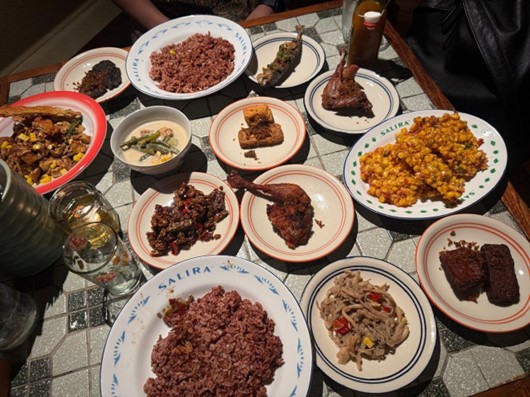
Source: Photo by the author
Meals are viewed less as “something to be eaten alone” and more as “something to be shared with others.”
Underlying this is the value of Gotong Royong (mutual aid and support). Eating together and sharing food are naturally woven into daily life.
Furthermore, in Indonesia, it is common for two or three generations to live together, or for relatives’ children to stay as boarders. Consequently, many households prepare meals based on the number of people who will be eating. As a result, it has become the norm to cook large quantities of food at once.
This lifestyle is also strongly reflected in purchasing behavior.
People often buy groceries in bulk at markets and supermarkets, and it is not uncommon for households to own not only a large refrigerator but also several medium-sized ones. Some families even separate their storage between raw ingredients and prepared foods, or keep commercial-grade freezers in their homes.

Mealtimes also have their own distinct characteristics.
On weekdays, since each family member has a different daily routine, people often eat the food set out on the table whenever they like. On the other hand, on weekends, family and relatives gather, and time spent gathered around the table in a lively atmosphere is highly valued.
In other words, the possibility of “always eating with someone” is a constant part of daily life. These values are also reflected in household appliances and tableware.
In Indonesian households, it is common to find large rice cookers that hold 5 to 10 cups of rice—a size rarely seen in Japan—as well as large pots, large serving platters, and a large number of spoons and forks.
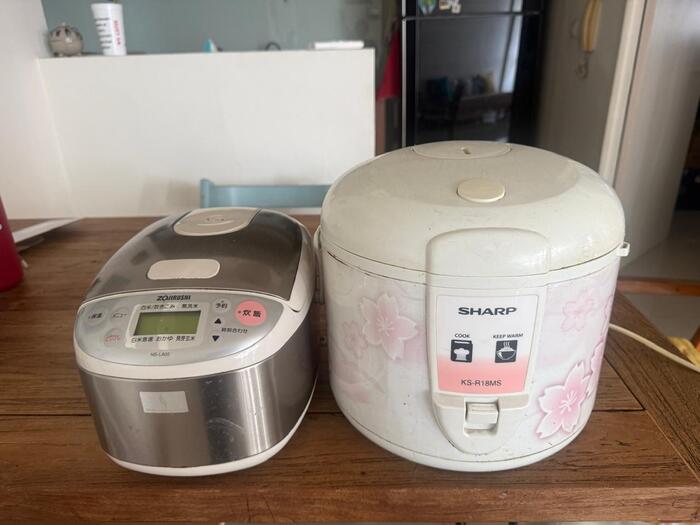
Photo on the left: A high-performance Zojirushi rice cooker (2–3-cup capacity) brought from Japan
Photo on the right: A 10-cup SHARP rice cooker designed for the local market, purchased in Jakarta
While Japanese rice cookers are multifunctional and high-performance, they are sometimes criticized for having “small capacities that require multiple cooking cycles” or for being “too complicated due to their many features.” In typical Indonesian households, as shown in the photo above (right), simple 10-cup models that only cook and keep rice warm are the norm. Even families of three to five people often use large rice cookers, and it is not uncommon for households with two generations living together to own two 10-cup models.
Indonesian cuisine is typically served by placing rice and side dishes on a single plate; the culture of using separate dishes for each item, as is common in Japan, is not as prevalent. Instead, it is not uncommon for households to own 20 to 30 plates of the same type.
3. Alone or with others? Consumption based on “relationship assumptions” as reflected in dining out
In Indonesia, the choice of restaurant and dining style vary greatly depending on whether you’re eating alone or with a group.
When dining alone, people often go to establishments known as “Warteg” or “Kantin.” Both serve meals on a single plate, offering a quick and affordable dining experience.
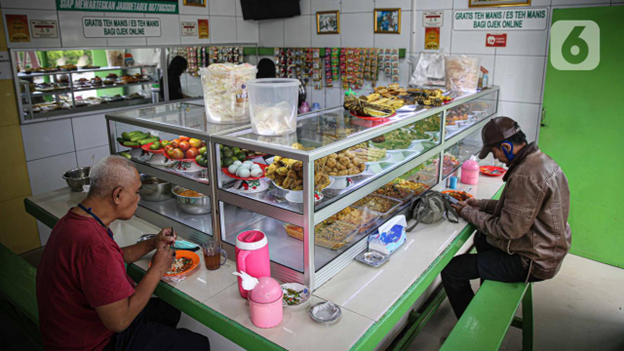
Warteg is a casual eatery where you point to the dishes on display and have them served on a single plate. Prices range from about 20,000 to 35,000 rupiah (approximately 180 to 315 yen), and many people either eat quickly at the counter or take their food to go.
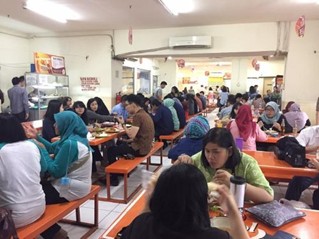
Kantin are similar to employee cafeterias or student dining halls, and they are often set up as food courts with multiple stalls. They have more seating than Warteg, and prices typically range from 30,000 to 50,000 rupiah (about 270 to 450 yen).
On the other hand, when dining with family, friends, or colleagues, restaurants where large platters of food can be shared are preferred. Here, too, the key consideration is not so much “what I want to eat” but rather “whether everyone can eat comfortably.”
Indonesia is a multi-ethnic and multi-religious nation, with differing dietary restrictions and preferences across religions. Consequently, in settings where people from diverse backgrounds gather, Indonesian cuisine—which everyone can enjoy with peace of mind—is overwhelmingly the preferred choice.
This “everyone-included” food culture is also reflected in spatial design.
Many Indonesian restaurants feature open-air private rooms called “gazebos.” With straw mats laid over wooden or bamboo floors, guests remove their shoes to sit, and these spaces are highly popular as places where even large groups can relax and enjoy a meal.
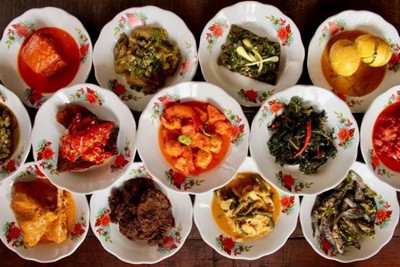
Padang cuisine is also emblematic of a dining culture centered on sharing. Although it originated on the island of Sumatra, it is now widely enjoyed throughout Indonesia.
At Padang restaurants, as soon as you sit down, 20 to 25 different dishes are brought to your table without you even having to order. You choose the ones you like, share them, and pay only for what you’ve eaten.
Source: https://news.kokikit.com/pilihan-lauk-nasi-padang-yang-lezat-mana-favoritmu/
With this format, there is virtually no time spent choosing from a menu or waiting for food to be prepared. Furthermore, since even large groups can start eating immediately, it is used in a variety of settings, such as company gatherings and family meals.
In other words, here too, the emphasis is on both “eating together” and “being able to start eating smoothly.”
In recent years, restaurants with counter seating and those catering to solo diners have been increasing, particularly in Jakarta’s malls, but the culture of sharing meals with others remains deeply ingrained.
Furthermore, this relationship-oriented dining culture is deeply intertwined with religious observances.
While it is often assumed that sales in the restaurant industry decline during Ramadan (the month of fasting), it is actually the period with the highest sales of the year.
In Indonesia, there is a custom called “BukBer (Buka Puasa Bersama),” and it is common to break the fast after sunset by dining with family and friends.
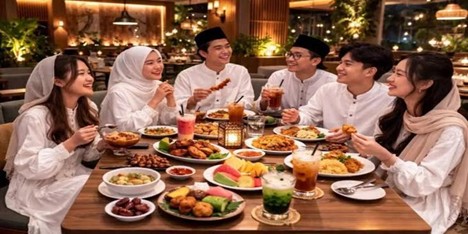
During this period, restaurants, hotels, and cafes offer special packages, attracting large crowds. Rather than a decrease in the number of meals due to fasting, a distinctive pattern of consumer behavior emerges: demand for dining out actually increases as opportunities to eat together with others grow.
Since BukBer lasts for about a month, it can be considered the most important sales season of the year for the food and beverage industry.
4. “Don’t Buy Just for Yourself”: “Sharing” Consumption Rooted in Daily Life
In Indonesia, “sharing food” is not a special act but rather a fundamental part of daily life. This culture extends beyond the home and restaurants, permeating various aspects of daily life, including the workplace, schools, and communities.
For example, when people feel like eating something, it is rare for them to buy just enough for themselves. Many people buy extra food with the expectation of sharing it with at least a few people around them, their team, or in some cases, the entire company or class.
This mindset—“I’ll eat some myself, but I’ll also share with those around me”—is naturally woven into daily life.
In particular, the custom of bringing food to share is deeply rooted during milestone events such as birthdays, the first day of employment, retirement, or sales achievement celebrations. Even in schools, it is not uncommon to see someone bring food to share with everyone at the end of a semester.
This consumer behavior, based on the expectation of sharing, is strongly reflected in corporate product design.
Delivery services like Grab (GrabFood) and Gojek (GoFood) offer value-packed set menus designed for large orders, catering to the demand for sharing among multiple people.
A similar trend can be seen among restaurant chains as well.
Pizza Hut sells 1-meter-wide pizzas that are easy to share among large groups, and they are pre-cut into squares for easy portioning.
In addition, the doughnut brand Lunas Doughnuts offers a 30-piece box designed for sharing, rather than the standard 12-piece box. These boxes are often used for gatherings with large groups, such as at companies, schools, and birthday parties.

Burger King also offers a 9-burger combo and a menu designed for large orders that combines rice, fried chicken, and burgers.
What these products have in common is that they are designed with “sharing” in mind, rather than “individual consumption.”
While eating may seem like a personal act, in Indonesia it functions as a “social act” for building, deepening, and maintaining relationships with family, colleagues, and friends.
Consequently, important selection criteria go beyond whether something is “delicious” or “affordable”; factors such as “whether many people will like it,” “whether it’s easy to share,” and “whether it’s easy to distribute” also play a significant role.
In other words, in Indonesia, “who to share with” and “how to share” influence consumer behavior even more than “what to buy.”
This act of “sharing” itself serves as a means of putting the culture of mutual aid—symbolized by Gotong Royong—into practice in everyday life.
5. It’s not just a “private family space.” It’s a home designed with the expectation of welcoming guests.
In Indonesia, a home is not merely a “space for individuals or families.”
Because the culture deeply values relationships with family, relatives, and neighbors, a key characteristic of Indonesian homes is that they are designed as “places where people gather.”
Consequently, regardless of the size of the home, particular emphasis is placed on “spaces for welcoming guests,” such as the Ruang Tamu (guest room) and Ruang Keluarga (family room).
In traditional homes, it is common to find a table and chairs placed in front of the entrance, with the guest room located just beyond, followed by the living and dining area further back.
When guests arrive, the natural flow is to first chat over tea in front of the entrance or in the guest room, and then move to the living room to eat a meal together with the family.
On the other hand, when neighbors drop by in the evening, they often do not enter the house but simply have a brief conversation at the table and chairs in front of the entrance.
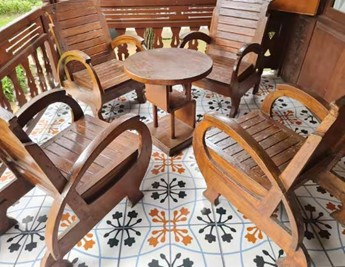
Due to the tropical climate, many homes feature a tiled, open-air terrace-like area in front of the entrance, furnished with wooden benches, chairs, and small tables, which also serves as a gathering place for socializing.
This concept of “designing with guests in mind” is also reflected in the kitchen design.
In Indonesian homes, it is not uncommon to find houses with two types of kitchens: the “Dapur Kotor” (dirty kitchen) and the “Dapur Bersih” (clean kitchen).
The Dapur Kotor is the actual cooking space located at the back of the house, out of sight of guests, and is used for deep-frying and preparing large quantities of food. It is often a simple, open-air structure where pots, cooking utensils, and refrigerators for food ingredients are kept.
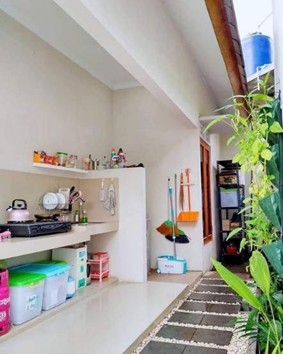
Source: https://demix.co.id/desain-dapur-mungil-terbuka/
In contrast, the Dapur Bersih is an “open kitchen” located near the living and dining areas. Cooking itself rarely takes place here; instead, it is used for reheating food, serving meals, and preparing beverages. Since it is a space visible to guests—where tableware, drinks, and prepared dishes are displayed—it is always kept clean.
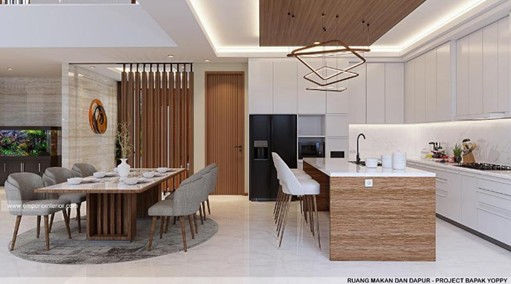
In other words, homes in Indonesia are designed not so much as “spaces where only the family can live comfortably,” but rather as “spaces for maintaining pleasant relationships with others.”
6. Family Gatherings and Ethnic and Religious Events
The times of year when visitor numbers peak are during the festive seasons of various ethnic and religious groups.
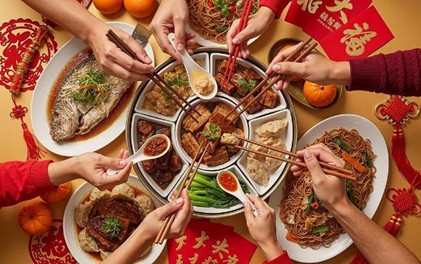
For Muslims, families and relatives gather on weekends during Ramadan (the month of fasting) to share a “Buka Puasa” (the meal breaking the fast). Additionally, during Eid al-Fitr (the festival marking the end of Ramadan) and Eid al-Adha (the Festival of Sacrifice), it is customary to dress in formal attire and celebrate with family and relatives over a meal.
Whether it’s Easter or Christmas for Christians, or the Lunar New Year for the Chinese community, many people gather at home to celebrate their respective religious and cultural holidays.
This cultural tradition is strongly reflected in wedding ceremonies.
While the use of hotels and wedding venues is becoming more common in urban areas, in rural regions the custom of holding the wedding at the bride’s parents’ home still persists.
In the morning, a religious ceremony is held with only family and close relatives, and the reception begins in the afternoon. The reception is typically a standing buffet-style event, and it is not uncommon for not only those who received invitations but also their families, friends, and even neighbors to attend.
In Indonesia, it is believed that “the more people who celebrate the wedding, the happier the marriage will be,” creating a very open and welcoming atmosphere.
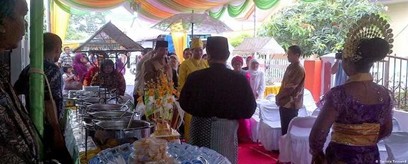
Source: https://www.dw.com/id/pertama-kali-melihat-acara-pernikahan-di-indonesia/a-58053862
Meanwhile, lifestyles in urban areas are also changing.
Many young people who have come to Jakarta from rural areas to work live in small apartments or in accommodations known as “KOST.”
The term “KOST” derives from the Dutch phrase “In de kost” and refers to a type of boarding house where residents rent a room in a large house and share facilities such as the kitchen, living room, and shower.
Historically, these spaces have functioned as “communities of mutual support” to prevent loneliness in the city, where residents living in the same KOST exchange information, eat meals together, and study together.
However, in recent years, with the spread of social media and smartphones making it possible to connect with family and friends online, values regarding “personal space” have gradually shifted.
Currently, small apartment-style KOSTs are on the rise. A “half-private, half-shared” style—where each room has its own shower and toilet and includes Wi-Fi and laundry services—is gaining popularity.
In particular, modern KOSTs like COVE are becoming more widespread, resembling small-scale serviced apartments rather than traditional shared housing.
Even so, many young people still hope to “buy a home in the future and live a life where they can invite family and friends over.” In other words, even as lifestyles change, the value of “wanting a home where people can gather” remains deeply rooted in Indonesian society.
7. Summary
When I first started living in Indonesia, what surprised me most was the “culture of sharing” that existed as a matter of course in everyday life.
In Japan, too, there is a custom of handing out souvenirs after traveling or visiting one’s hometown. However, in Indonesia, this is done much more routinely and naturally.
In a company with around 100 employees, someone was handing out food almost every day. It wasn’t just on special occasions like new hires, retirements, or the end of the fiscal year; cookies, bagged snacks, and donuts that someone had bought would routinely make the rounds in the office.
One day, a female colleague offered me some cookies. There were hardly any left in the box, so I blurted out, “Why don’t you just eat them all yourself?” She replied naturally:
“Because when I find something delicious, I want to share it with others.”
Hearing those words, I strongly sensed the Indonesian “sense of sharing joy with others.”
In Indonesia, there are also many opportunities to be invited to people’s homes or to invite others over, rather than going to restaurants.
Some homes are luxurious, while others are modest, and some are by no means wealthy. However, every household shares a common attitude of doing their utmost to be hospitable. And it’s not uncommon to be naturally invited to “stay the night.”
At first, I was often taken aback by this closeness. But as I lived there, I came to realize that a sense of security—that “you can always rely on us” and “we help each other when in trouble”—is deeply rooted in this society. I also grew to accept without hesitation when my Indonesian husband’s family and relatives gathered at our home.
Indonesia is a multi-ethnic and multi-religious nation, and values vary greatly depending on generation and region. Even so, the desire to “stay connected with others” and “cherish relationships” is something shared by many people.
Perhaps that is why Japanese people in their 60s and older often feel a sense of “nostalgia” when they visit Indonesia.
This may be because the “warm, close-knit relationships” between people and between people and society—the kind that once existed in Japan—still remain deeply ingrained in daily life here.