目次
- 1. Analysis of the Process from Initial Consideration to Purchase Decision, Based on Interviews with EV (SUV) Buyers in Bangalore
- 2. The target group consists of five EV (SUV) buyers in Bangalore
- 3. The Starting Point for EV Consideration: A “Sense of the Future” That Attracts Consumers
- 4. Information Gathering: “Third-Party Touchpoints” Drive the Purchase Journey
- 5. From Comparison to Final Decision: Why I Was Drawn to It and the Moment My Concerns Were Eased
- 6. After Purchase: An EV isn’t just a second car—it becomes your primary vehicle right away
- 7. Conclusion: People consider EVs for their “futuristic appeal” but buy them for their “reliability”
1. Analysis of the Process from Initial Consideration to Purchase Decision, Based on Interviews with EV (SUV) Buyers in Bangalore
In India’s electric vehicle (hereinafter EV) market, models such as the VinFast VF7, Mahindra BE6, BYD Atto 3, and Hyundai Creta EV are being compared, making consumers’ decision-making process increasingly complex. EVs are viewed not merely as a means of transportation, but as symbols of technology, sustainability, and a futuristic lifestyle. At the same time, in the final stages of the purchasing process, practical factors such as brand trust, service infrastructure, and peace of mind regarding long-term ownership become critical considerations.
In this article, we outline the purchasing journey in the Indian EV market based on in-depth interviews with five EV (SUV) buyers residing in Bangalore. The focus is not on comparing the specifications of each model, but rather on deciphering the psychological process consumers go through when considering an EV and ultimately deciding to purchase one.
What has become clear is that the purchasing journey in the Indian EV market follows a structure where “it begins with expectations and is decided by trust.”
2. The target group consists of five EV (SUV) buyers in Bangalore
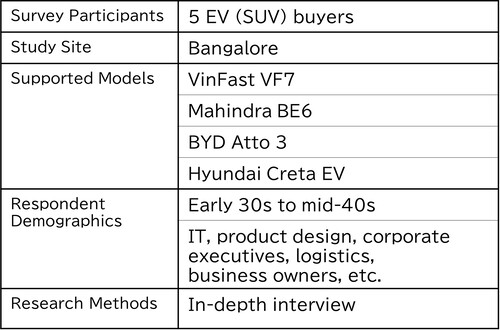
This analysis is based on in-depth interviews with five EV (SUV) buyers residing in Bangalore. The models examined were the VinFast VF7, Mahindra BE6, BYD Atto 3, and Hyundai Creta EV. The respondents, ranging in age from their early 30s to mid-40s, comprise a group of relatively high-involvement consumers working in fields such as IT, product design, corporate management, logistics, and business ownership.
3. The Starting Point for EV Consideration: A “Sense of the Future” That Attracts Consumers
The factors that prompted this consideration were technology, environmental awareness, low cost, and the impact on our daily lives
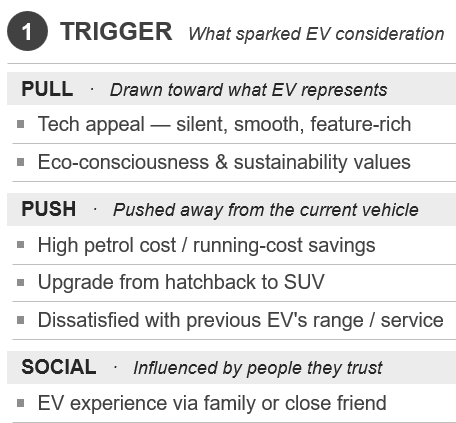
The decision to consider an EV is not driven by a single reason, but rather by a combination of multiple factors. In this interview, EVs were perceived not merely as a means of transportation, but as symbols of technology and a futuristic lifestyle. Quiet, smooth driving, a wealth of features, and advanced equipment are major attractions for those considering EVs.
At the same time, sustainability and environmental awareness were cited as important motivations. EVs are recognized not only as an “environmentally conscious choice” but also as a “choice that anticipates the future of mobility.”
In other words, EVs are valued not only for their practicality but also for their forward-looking appeal.
On the other hand, the decision to consider an EV does not stem solely from a desire for a futuristic experience. Practical reasons, such as high gas prices and the desire to reduce running costs, also serve as entry points for consideration. Additionally, there was a noticeable desire to upgrade from a hatchback to an SUV. EVs are not just “environmentally friendly cars”; they also present an opportunity to switch to a larger, more comfortable vehicle with a stronger presence.
Furthermore, the EV experiences of family members and close friends were also driving this consideration. Since EVs are still a new category, the fact that someone close to them is actually using one lowers the psychological barrier. Especially for emerging brands and new technology categories, “testimonials from actual users” are more effective in building trust than advertising.
4. Information Gathering: “Third-Party Touchpoints” Drive the Purchase Journey
YouTube, Test Drives, and Reviews — Sources of Information to Help You Move Forward with Your Purchase Decision
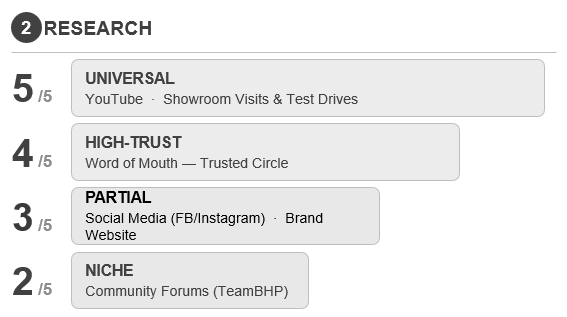
When gathering information about purchasing an EV, all respondents in this survey utilized YouTube, showroom visits, and test drives. Furthermore, most respondents placed a high value on word-of-mouth recommendations from trusted acquaintances, such as family and friends. It is not only official brand information but also third-party touchpoints—such as reviews, personal experiences, test drives, and word-of-mouth—that strongly influence the purchasing journey.
Looking at the importance of information sources, YouTube, showroom visits, and test drives were “universal touchpoints” used by everyone. Word-of-mouth from acquaintances, friends, and family serves as a highly trusted source of information. On the other hand, social media and brand websites were used only by a portion of respondents, while communities and forums such as TeamBHP were positioned as more niche sources of information.
This indicates that in high-involvement categories with significant uncertainty, such as EVs, consumers do not make decisions based solely on information provided by the brand. The authenticity conveyed by third parties, the experience of actually touching the car, and the endorsement of people close to them are what move the consideration process to the next stage.
5. From Comparison to Final Decision: Why I Was Drawn to It and the Moment My Concerns Were Eased
(1) Models that attract buyers with their specs and alleviate their concerns are chosen
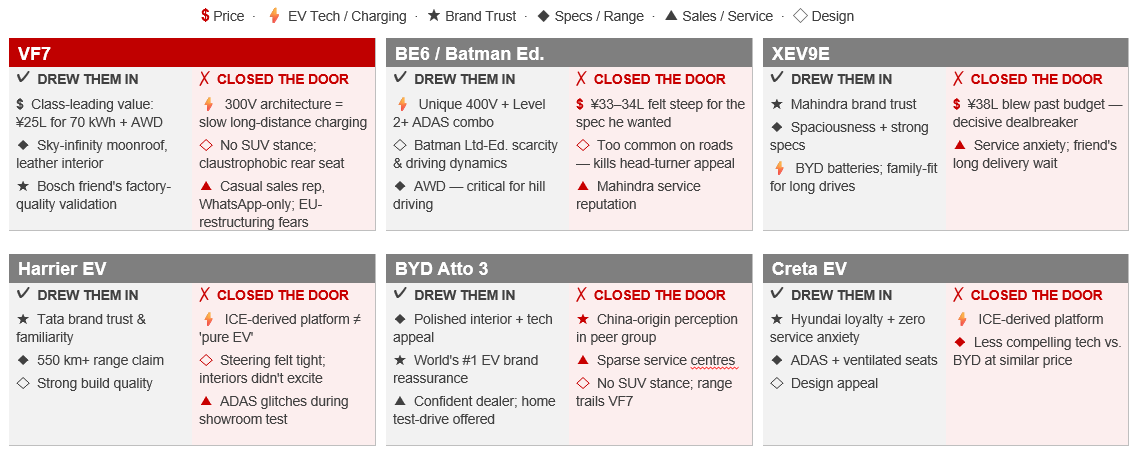
When comparing EVs, each model had both a “selling point that attracts consumers” and “concerns that cause hesitation.” The comparison criteria can be categorized into six areas: price, EV technology and charging, brand trust, specs and range, sales and service, and design and presence.
However, the ultimate deciding factor for purchase was not simply “the car with the best performance.” Each buyer selected the model that best addressed their primary psychological concerns—scarcity, trust, sustainability, value for money, and desire for design.
In other words, while consumers are strongly drawn to a specific appeal of each model, one particular concern looms large just before purchase. When buying an EV, decision-making is influenced not only by the relative merits on the spec sheet but also by a comprehensive sense of security that encompasses the brand, service, and social perception. This means consumers aren’t simply buying “cars that seem good.” What they are choosing is “a car they feel confident choosing.”
(2) VinFast VF7: Strong Product Appeal, but Trust Is a Question Mark
The VinFast VF7 was perceived as having strong appeal due to its value for money, featuring a 70kWh battery, AWD, a moonroof, and leather interior. In particular, the dual-motor performance and premium interior experienced during test drives generated a strong “wow” factor among potential buyers.
On the other hand, concerns about long-distance charging range, a perceived lack of SUV-like presence, and worries regarding sales support and the brand’s future served as factors leading to disengagement and anxiety. While the VF7 attracts buyers with its product appeal, trust in the brand and its services is necessary to convert that interest into a purchase.
(3) Mahindra BE6: Rarity Fulfills a Sense of “Self-Expression”
The Mahindra BE6 was highly regarded for its 400V architecture, Level 2+ ADAS, the rarity of the Batman Edition, and its driving performance. In particular, the rarity of the Batman Edition—limited to just 999 units—had the power to transform a purely functional choice into a “personalized possession.”
On the other hand, the high price, concerns about service reputation, and a decline in exclusivity due to the increasing number of these vehicles on the road were factors of concern during the consideration phase.
(4) BYD Atto 3: Practical Peace of Mind Drives Purchase
The BYD Atto 3 was praised for the quality of its interior, the peace of mind that comes with being the world’s No. 1 EV brand, and dealer support. In particular, the fact that it addressed past dissatisfaction with EVs, along with dealers bringing test drive vehicles to buyers’ homes, contributed to a sense of practical reassurance.
On the other hand, psychological resistance to Chinese brands, the scarcity of service centers, and perceived disadvantages in SUV-like characteristics and driving range were cited as sources of concern.
(5) Hyundai Creta EV: Accumulated Trust Leads to Risk Aversion
The Hyundai Creta EV was praised for Hyundai brand loyalty, minimal service concerns, and features such as ADAS and ventilated seats. A major factor for the purchaser was their experience of owning three Hyundai vehicles in the past without ever encountering a problem. This led to the conclusion, “Why take a risk?”
On the other hand, perceptions regarding its ICE-derived platform and a lack of a cutting-edge feel as an EV served as deal-breakers for other prospective buyers.
6. After Purchase: An EV isn’t just a second car—it becomes your primary vehicle right away
EVs Become the Main Vehicle in the Household Within Just a Few Weeks of Purchase
All five respondents in this survey owned multiple vehicles. However, after purchasing an EV, they rapidly switched from gasoline-powered cars to EVs, and EVs have become their primary means of daily transportation. This demonstrates that EVs can become the main vehicle in a household immediately after purchase, rather than serving merely as a “second car” or a “car for short trips.”
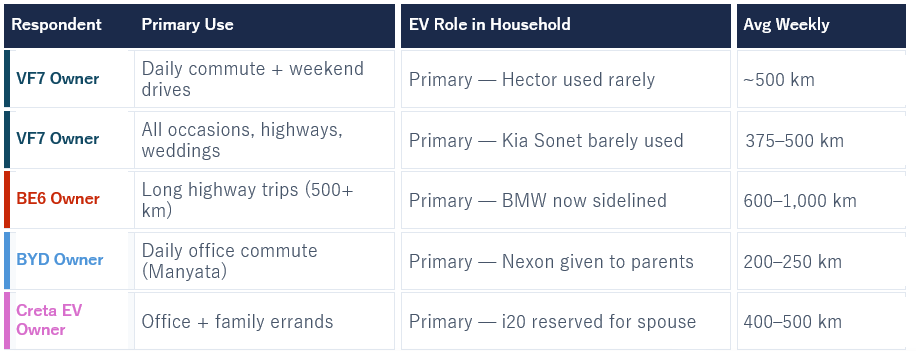
Behind this trend lie factors such as quiet operation, low running costs, ease of driving, and the satisfaction and pride that come from owning a futuristic vehicle. EVs are not chosen solely for their environmental performance. The comfort that makes you want to use them every day, the peace of mind they offer for long-distance travel, and the joy of ownership are all increasing how often they are used after purchase.
When promoting EVs, environmental performance and technological innovation alone are not enough. It is necessary to convey what daily life will be like after purchase—how comfortable it will be and how reassuring it is to use.
7. Conclusion: People consider EVs for their “futuristic appeal” but buy them for their “reliability”
In the Indian EV market, consumers view EVs as a futuristic and attractive option. Quiet operation, technology, sustainability, low running costs, and design are all strong reasons for them to consider purchasing one. For consumers, EVs are more than just a means of transportation; they have become a symbol of a futuristic lifestyle and a new ownership experience.
However, in the final stages of the purchasing decision, key factors include whether the brand is trustworthy, whether service is available, and whether the vehicle can be driven with peace of mind over the long term. Especially for new brands and new categories, it is essential to design not only a compelling product but also a sense of security that extends beyond the purchase.
The purchasing journey in the Indian EV market “begins with expectation and is decided by trust.” A sense of the future is needed to attract consumers. However, trust is essential to actually drive them toward a purchase. It is not just specifications or buzz, but a comprehensive design for peace of mind—encompassing test drives, word-of-mouth, service, and the post-purchase experience—that ultimately influences brand choice.
In the next installment, we will delve into where emerging EV brands specifically stumble and where they can find opportunities for success within this purchasing journey, based on feedback from both buyers and non-buyers of the VinFast VF7.