目次
- 1. Introduction: Japan Brand — Lost Presence and the Potential for Renewed Growth —
- 2. Home Appliances: Chinese Brands Gaining Ground Amid Shifting Values
- 3. Cosmetics: How Social Media Is Changing “Skepticism Toward Chinese Cosmetics”
- 4. Food: High regard for Japanese culture—Thais are embracing its popularity
- 5. Trust in Japanese brands remains strong. The key to renewed growth lies in “emotion and storytelling.”
1. Introduction: Japan Brand — Lost Presence and the Potential for Renewed Growth —
“Our generation grew up watching anime like *Doraemon* and *Pokémon*. Our parents trust Japanese brands, so the cars and appliances at our parents’ house are basically all Japanese brands. Chinese brands? There are some counterfeits and poor-quality products out there, so we’re very skeptical of them.”
To understand the current status of Japanese brands, we spoke with Thai women in their teens through their 30s, and they all agreed that “Japanese brands are reliable” and “they don’t break.” On the other hand, there still appears to be deep-rooted distrust toward Chinese brands.
However, contrary to what they say, brands and services originating in China are widely integrated into the daily lives of Thais. They use the Chinese app “TikTok” to gather information, adorn their bags with characters from the Chinese brand “POP MART,” and Chinese-made EVs (electric vehicles) cruise the streets. Among siblings and friends, trips to China, Chinese restaurants, and Chinese TV dramas are also popular.
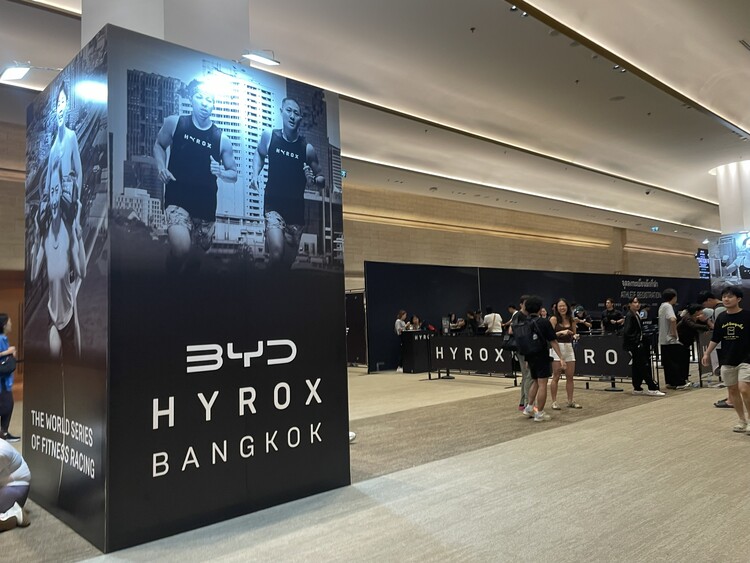
“HYROX” is a fitness competition that is gaining popularity, particularly among people in their 30s.
At “HYROX BANGKOK,” held in August 2026 and attended by many influencers,
Chinese automaker BYD served as the title partner.
2. Home Appliances: Chinese Brands Gaining Ground Amid Shifting Values
What home appliance brands do typical middle-income households in Thailand choose?
For “display appliances” like televisions, which are placed in the living room, consumers prioritize a balance between screen quality, design, and price—an area where South Korean brands hold a strong position. On the other hand, for large appliances with a long lifespan, such as refrigerators and air conditioners, reliability—specifically the perception that they “won’t break” and are “safe”—is the deciding factor in purchasing. It seems that some consumers opt for established Japanese brands, even if they are slightly more expensive. In contrast, Chinese brands are gaining a stronger foothold in the market for small appliances, such as electric fans, vacuum cleaners, and bathroom scales.
However, this division of market segments among brands is by no means set in stone.
Xiaomi, a Chinese smartphone and home appliance manufacturer, made a full-scale entry into the Thai market about 10 years ago. Against the backdrop of growing concerns about air pollution and the COVID-19 pandemic, the company’s small appliances—such as air purifiers, vacuum cleaners, and toasters—have become increasingly common in Thai households. They are characterized by affordable prices and simple designs that blend seamlessly with home interiors. Consumers who have actually used these products have shared their experiences on social media, expressing everything from dissatisfaction with quality to satisfaction with their value for money.
It could be said that the past decade or so has served as a “trial period” for Chinese home appliances among Thai consumers. During this time, values regarding home appliance selection may have shifted from “high-quality products that last a long time, even if they’re expensive = Japanese brands” to “inexpensive, well-designed products that can be replaced if they break = Chinese brands.”
Trust in Japanese brands remains strong. Nevertheless, in everyday life, there are increasing instances where Chinese brands are being chosen. What criteria do Thai consumers use when selecting brands? Furthermore, how is the presence of Japanese brands changing in the face of the rise of Chinese and South Korean brands?
In this article, we will examine the presence of Japanese, South Korean, and Chinese brands from the perspective of Thai consumers, as well as the underlying shifts in values and purchasing behavior. Since the products and brands purchased in Thailand vary significantly by income level, this article will focus primarily on the middle- to upper-middle-income groups, who have traditionally been the main purchasers of Japanese brands.
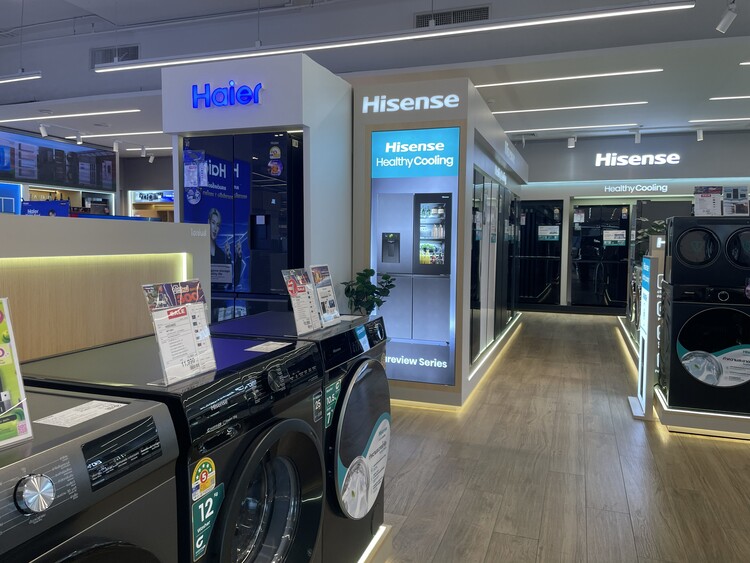
In the home appliance section of the shopping mall,
the sales floor space dedicated to Chinese brands had expanded without anyone noticing.
In February 2026, the Thai news site Marketeer reported that the domestic home appliance market in 2025 reached 84 billion baht (approximately 400 billion yen), with Chinese brands accounting for about 50 percent of the market share by country, and Japanese and South Korean brands accounting for the remaining 50 percent. In addition, the news site TNN reported that, against the backdrop of Chinese companies acquiring the home appliance businesses of Japanese manufacturers, Chinese brands are rising to prominence, replacing Japanese brands that have long been familiar to consumers. The presence of Japanese brands in the home appliance market is definitely waning compared to the past.
News Site TNN
In recent years, we’ve started to see price-cut promotions on major home appliances from Chinese brands. On social media, there are positive reviews from people who’ve purchased Chinese-brand air conditioners at a good price and are satisfied with their performance. It’s quite likely that consumers who are due to replace their major home appliances will consider Chinese brands as an option in the future.
So, will Thai consumers purchase products regardless of brand, provided they offer a certain level of quality at an affordable price? While Chinese brands place a strong emphasis on the balance between price and quality, do the same value standards apply to Japanese, Korean, and Western brands? This is an interesting point to consider when thinking about future brand choices.
3. Cosmetics: How Social Media Is Changing “Skepticism Toward Chinese Cosmetics”
Japanese brands continue to hold a strong presence in the cosmetics and skincare markets. Cosmetics brands such as CANMAKE and CEZANNE are popular among women in their teens through their 30s, and skincare products like Hada Labo and Kanae Nadeshiko also enjoy strong, loyal support. Since cosmetics come into direct contact with the skin, quality and safety are top priorities; as a result, there is a tendency to choose brands from Japan, South Korea, and the West as “products that can be used with confidence.” On the other hand, the women we interviewed this time were all negative toward Chinese brands. They have heard firsthand accounts of people experiencing skin irritation after using Chinese products and say they want to avoid them precisely because they come into direct contact with the skin. In the cosmetics category, Japanese brands continue to enjoy a high level of trust, on par with Korean and Western brands.
However, these criteria for choosing cosmetic brands may change in the future. Behind this shift lies the influence of social media, particularly TikTok. Listening to young women, it becomes clear that interest in products they repeatedly see on social media can sometimes outweigh their loyalty to a brand’s country of origin.
For example, a woman who typically prefers Japanese brands for skincare recently purchased the “Booster Pro” facial device from the South Korean brand Medicube. This product gained attention in Thailand after LISA, the Thai member of the South Korean girl group BLACKPINK, featured it on her Instagram in late 2025 (https://vogue.co.th/beauty/article/lisa-skincare-routine-medicube). She explained that she became curious about it after seeing it repeatedly on social media, so she bought it—and later purchased a toner from the same brand as well.
Even women who are generally skeptical of Chinese cosmetics said they’ve become curious about the Chinese brand Flower Knows because they see it frequently on TikTok. Flower Knows is known for its glamorous packaging that makes users feel like a princess, and it’s gaining support as a brand that “sells a story”—one whose unique aesthetic spreads organically across social media. There are many reviews by Thai users, and positive feedback is seen not only regarding the product’s cute appearance but also its quality.
Flower Knows, where you can feel like a princess, is also well-known for its quality.
In Thailand, Chinese brands are gaining ground in the cosmetics category, and the term “C-Beauty” is becoming increasingly widespread. According to a June 2025 report by the news site Post Today (https://www.posttoday.com/smart-sme/725936), Thailand’s imports of Chinese cosmetics reached a record high of 5.3 billion baht (approximately 25 billion yen) in 2024. This figure is 1.5 times the pre-pandemic level, and the average annual growth rate from 2019 to 2024 reached 8.4 percent. In fact, the number of Chinese brand displays in cosmetics sections is increasing, and there is a sense that they are gaining momentum to rival Japanese and South Korean brands.
4. Food: High regard for Japanese culture—Thais are embracing its popularity
In the food category, Japan continues to have a strong presence, particularly in the restaurant industry and with ingredients originating in Japan.
Japanese cuisine is highly popular in Thailand, where it has established a reputation for being healthy and sophisticated. In recent years, conveyor-belt sushi chains and matcha drinks have become especially popular. However, while Japanese cuisine enjoys a favorable image, the reality is somewhat different when it comes to whether that image directly translates into the strength of the “Japanese brand.”
A prime example of this is the matcha boom sweeping Thailand. Matcha consumption has surged, and tea exports from Japan have also grown significantly in recent years. However, the driving force behind this boom in Thailand is actually Thais who have learned about matcha and how to prepare it in Japan. They have opened matcha-specialty cafes in Bangkok and are continuously developing new ways to enjoy the beverage and new menu items tailored to Thailand’s climate and consumer preferences.
The image of “Japan” as the country of origin is certainly viewed favorably, and Japanese food culture is highly regarded. On the other hand, it is the Thais themselves who are capitalizing on this popularity by developing products and services to attract local consumers. It is important to note that a high regard for Japanese culture does not necessarily translate directly into purchases of Japanese companies’ products or Japanese-branded goods.
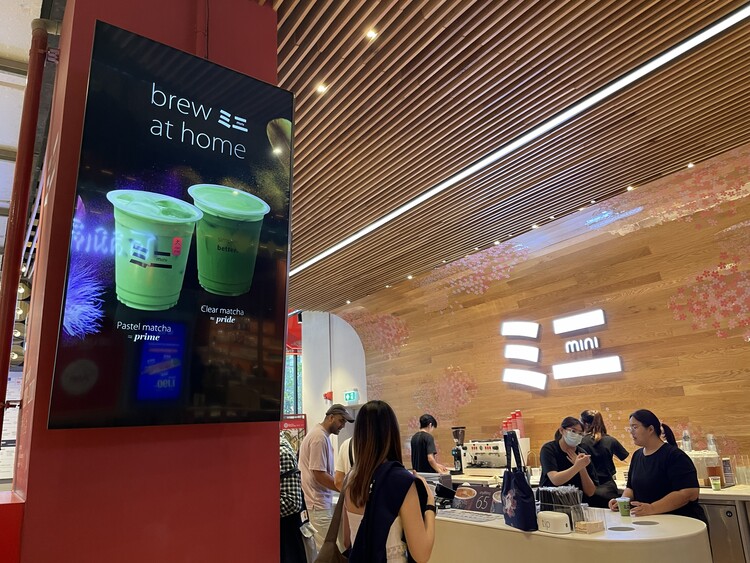
“Mini,” a matcha café run by a Thai owner, always has a line out the door.
5. Trust in Japanese brands remains strong. The key to renewed growth lies in “emotion and storytelling.”
The trust that Japan has built up in Thailand over several decades through its culture and technological capabilities is exceptionally strong, and it is surprising to see that this trust has been passed down not only to the baby boomer generation (born between approximately 1946 and 1964), who have a strong affinity for Japanese brands, but also to Generation Z. In areas that are “close to consumers’ daily lives”—such as products ingested, items that come into direct contact with the skin, and major purchases related to the safety of family life—Japanese brands continue to maintain a strong presence.
On the other hand, when it comes to “distant” daily necessities such as small household appliances, Thai consumers—while harboring some distrust toward Chinese brands—are accepting them due to their affordable prices, designs, and perceived value for money. This distrust toward Chinese brands has not completely disappeared. Nevertheless, actual purchasing behavior is beginning to change even before brand perceptions do.
What particularly stood out this time was that several of the Thai women we interviewed cited Dyson as a brand they were interested in. Not only is the brand highly regarded for its performance, but its displays in appliance stores are also designed to stand out. In addition to its high price and high quality, the brand’s unique values and worldview likely play a role in attracting Thai consumers.
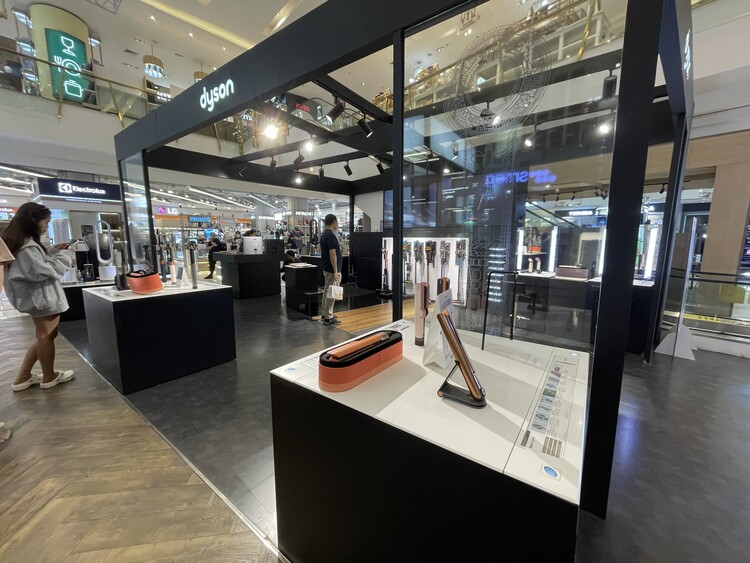
The Dyson product display stands out even in the home appliance section
Although the products are in the high-price range,
the display’s unique, special atmosphere is impressive
Until now, the image of “Japan = high quality and high performance” has been a major reason why Japanese brands are chosen in Thailand. However, looking at the purchasing behavior of the young women we spoke with this time, it’s clear that we’re no longer in an era where people choose products based solely on trust in quality.
Flower Knows, a Chinese cosmetics brand with designs and a brand aesthetic that make you want to share them on social media, and Dyson, which conveys a unique value and sense of exclusivity. What may be attracting modern Thai consumers is not just functionality and quality, but the unique appeal and stories that only those brands can offer.
The trust in quality cultivated over many years remains a major strength of Japanese brands. The key lies in how to leverage that strength while communicating values that resonate with consumers, inspire their admiration, and make them want to share them with others. I felt that this holds the key to the renewed growth of Japanese brands in the Thai market.