目次
1. Introduction
As global warming has become a major issue in recent years, the world’s average temperature has been rising year by year. Japan has also experienced a string of extreme heat waves in recent years, making air conditioners an indispensable item. Rather than simply being a means to ensure a comfortable lifestyle, they are increasingly becoming a household appliance essential for survival.
Given that the global market size for air conditioners is on the rise, it is expected that the penetration rate of air conditioners will continue to increase worldwide. On the other hand, it does not appear that “hot countries” necessarily have high air conditioner penetration rates. According to “Global Viewer” (conducted in 2025), a database of overseas consumers maintained by Intage, the air conditioner penetration rate in Southeast Asia (Malaysia, the Philippines, Indonesia, Thailand, and Vietnam) was approximately 60%.
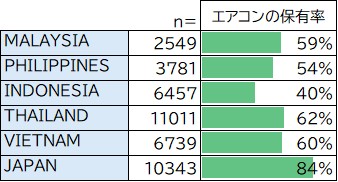
Figure: Air Conditioner Ownership Rate
(Base: Men and Women Aged 18–64 Nationwide in Each Country)
Source: Intage Global Viewer (2025)
Accelerate decision-making with smart overseas resident data
Global Viewer
This service provides reports tailored to your issues using questionnaire data on various actual conditions and attitudes of sei-katsu-sha in 11 countries (Asia and US) stocked by INTAGE.
The service covers 400 items, including actual behavioral conditions and awareness, values, and information contact related to various product and service categories.
This shows that the air conditioner penetration rate in Southeast Asia is lower than Japan’s 84%. Southeast Asia has higher temperatures and humidity than Japan, resulting in a climate with intense heat. Despite this, what are the reasons behind the lower air conditioner penetration rate compared to Japan?
Perhaps the answer lies in the lifestyle and ingenious methods people use to cope with the heat. In this article, we’ll focus on Vietnam to explore this question.
2. The Relationship Between Housing Types and Air Conditioner Ownership in Vietnam
Before we begin our analysis, I’d like to explain why we selected Vietnam from among the five Southeast Asian countries. Our hypothesis is that “households without air conditioning may have adopted specific design strategies in their homes, such as unique floor plans, ceiling heights, and sunshades.”
Vietnam features a wide variety of housing types, including detached homes such as townhouses (detached houses adjacent to one another) and shop houses (properties with retail space on the first floor and living space on the second floor, often facing major streets), as well as high-rise apartment buildings (condominiums) that have recently been constructed in urban areas. Therefore, it is reasonable to assume that these differences in housing types may influence indoor environments and the presence or absence of air conditioning. We therefore examined the presence or absence of air conditioning based on differences in Vietnam’s living environments using “Consumer Life Panorama,” Intage’s visual database of overseas consumers.
(1) Case 1: Townhouse
Upon examining townhouses—one of the most common housing types in urban Vietnam—we observed a pattern where air conditioners are installed only in the bedrooms, not in the living room.
Looking at the home’s layout, the living room is located immediately inside the front door. The entrance is covered by a roof, but the sides appear to be fenced off. It’s also evident that the roof over the entrance helps block direct sunlight. As a result, the structure appears designed to allow for good airflow without direct sunlight entering the living room. Furthermore, by creating a well-ventilated space that avoids direct sunlight, the design ensures that residents can remain relatively comfortable in the living room even without air conditioning. As can be seen from this, there is a significant difference compared to the residential layout in Japan, where rooms are accessed through an entranceway or hallway.
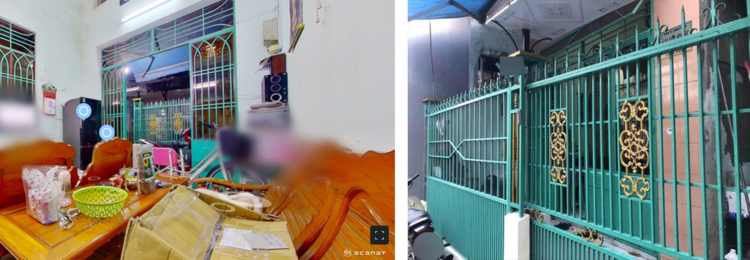
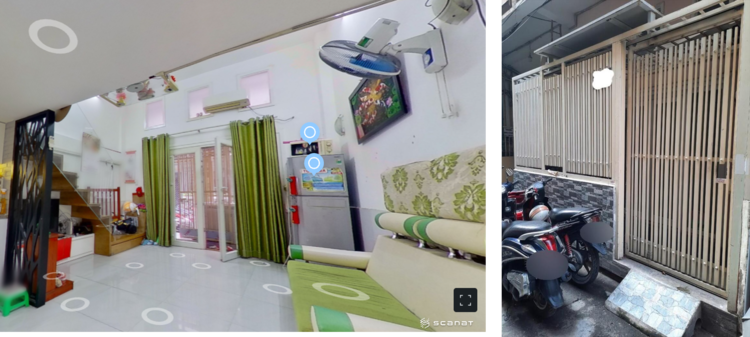
Photo: Living room of a townhouse in Ho Chi Minh City.
There is a lattice at the entrance, and the living room is immediately visible upon opening the door.
As a result, the layout allows for a steady flow of fresh air into the living room.
Source: Intage Consumer Life Panorama
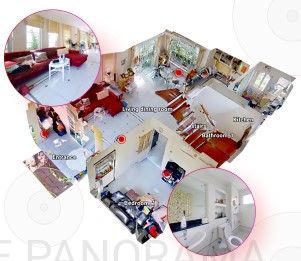
What is Consumer Life Panorama?
This is a website-type database that has accumulated visual data on more than 1,000 sei-katsu-sha from 18 countries around the world. The database includes many 3D models of living environments and 2D data of items owned by each sei-katsu-sha, and is useful for understanding overseas sei-katsu-sha, which is difficult to grasp using only letters and numbers.
Using visual data such as those cited in this column,
Compare the differences in the attributes of overseas consumers
To get a realistic understanding of the actual usage of each category
To understand the overall lifestyle of target consumers
etc., can be utilized as a “no-go” home visit survey.
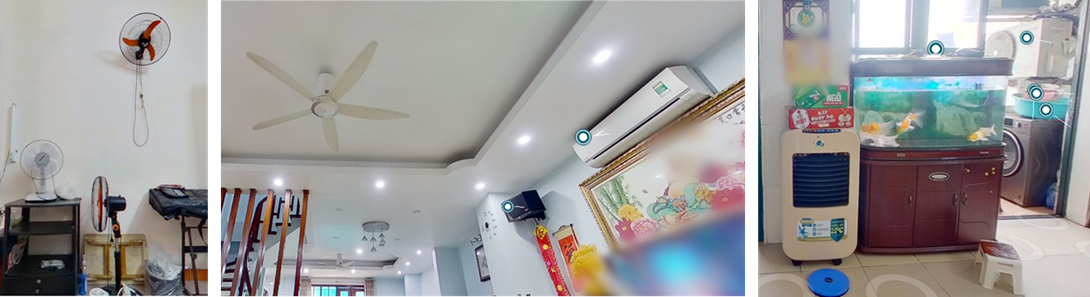
It is also common to see homes where an air conditioner is installed in the bedroom even if there isn’t one in the living room. This is likely because, while windows are left open during the day to allow for ventilation, at night—for security reasons—all windows and doors are closed, cutting off the flow of air through the house and causing the room to become hot without an air conditioner.
(2) Case 2: Condominium
On the other hand, it seems that many condominiums have air conditioning installed in the living room as well. Inside the unit, the entrance leads to the living room via a hallway.
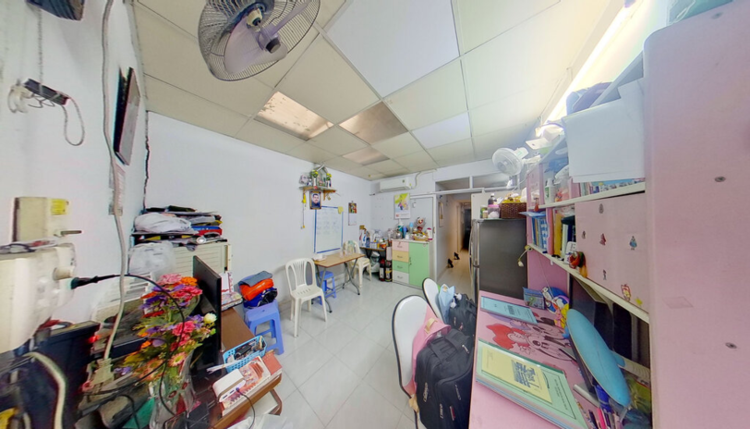
Photo: The living room of a condominium in Ho Chi Minh City.
Because there are no (or very few) windows, it is difficult for fresh air to circulate.
Source: Intage Consumer Life Panorama
The structure is very similar to that of Japanese apartment buildings. While this is one of the characteristics of multi-unit housing, condominiums are structurally enclosed by walls, creating a closed living space. As a result, ventilation is poor, and it is likely that residents would not be able to maintain a comfortable living environment without an air conditioner. This is probably why so many units are equipped with air conditioners.
3. Conclusion
In this article, we examined two types of housing in Vietnam and observed differences in air conditioner installation rates due to variations in room structure. In particular, the townhouses introduced in Case 1 feature a structure unique to Vietnam, which appears to be a design that evolved as an adaptation to the hot climate. However, with average temperatures rising year by year, it is becoming increasingly difficult to cope with the heat through architectural design alone. Air conditioners will likely remain an indispensable appliance for daily life moving forward.
Furthermore, this analysis revealed that what people are seeking through innovative housing designs and air conditioners is not merely “cool air” but a “comfortable environment.” I feel that air conditioners are not merely “devices” that simply deliver cool air; they hold infinite potential for creating comfortable environments. While the definition of comfort varies depending on a country’s culture and climate, gaining a deeper understanding of local conditions is paramount to pursuing the comfortable environments that air conditioners can provide.