目次
- 1. Introduction
- 2. Vietnam Edition: Family Bonds and Street Food Culture
- 3. Cambodia: Family Gatherings and Supporting Local Markets
- 4. Thailand Edition: Shared Platters at the Table and Thai Men Who Cook Well
- 5. Philippines Edition: A Festive Table to Enjoy with Everyone
- 6. India Edition: Family Mealtime Scenes and Attitudes Toward Rice
- 7. Indonesia Edition: Flexible Meal Times and Evolving Eating Habits
- 8. Shanghai, China: Side Dishes Take Center Stage and a Commitment to Fresh Ingredients
- 9. Saudi Arabia: Bulk Shopping at the Supermarket and Family Gatherings for Dinner
- 10. [Summary] Three Trends Emerging from Eight Countries
1. Introduction
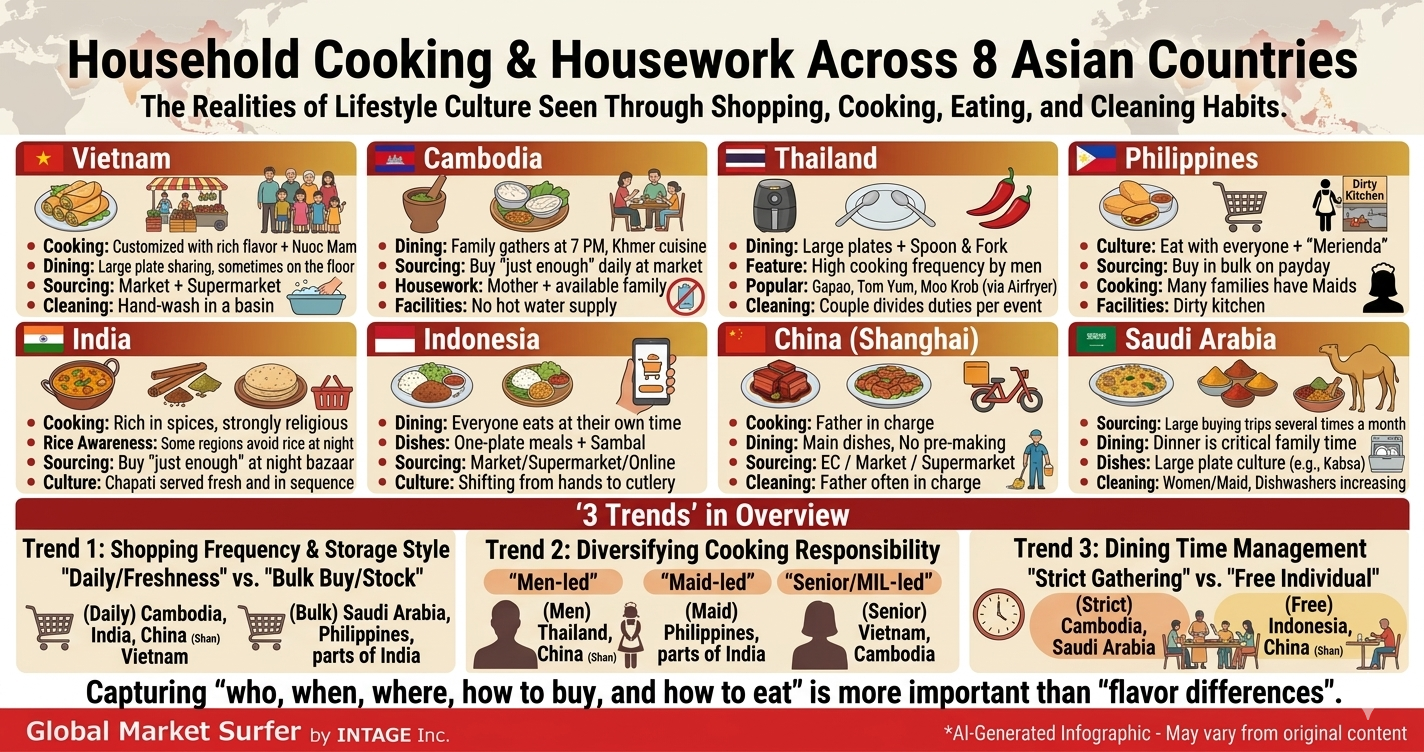
When expanding into global markets and developing locally tailored products and services, it is essential to deeply understand what is “commonplace” for local consumers. This is particularly true in the areas of ‘food’ and “household chores,” where a country's culture, family structure, and infrastructure conditions are strongly reflected.
This article introduces the “behavior when cooking” in Vietnam, Cambodia, Thailand, the Philippines, India, Indonesia, Shanghai, China, and Saudi Arabia. We cover everything from the real scenes at each country's dining tables and how ingredients are procured to daily eating habits at home.
Furthermore, the latter part of this article will unravel “three trends” useful for global marketing—revealed by surveying the living conditions across these eight countries—namely: food shopping and storage habits, changes in the kitchen's main role, and the diversifying time management of the dining table.
2. Vietnam Edition: Family Bonds and Street Food Culture
At Vietnamese dining tables, salty or richly flavored dishes that pair well with rice are favored. Staples include “ca kho to” (braised fish seasoned with nuoc mam), “cha gio” (fried spring rolls), and stir-fried water spinach with garlic. A distinctive feature is that diners customize their own flavors using nuoc mam, soy sauce, chili sauce, and other condiments.
Meals are typically served family-style on large platters, featuring salads, meat or fish dishes, and generously steamed white rice, allowing everyone to help themselves freely. Many households also enjoy meals together on the floor, placing dishes directly on the ground instead of using tables.
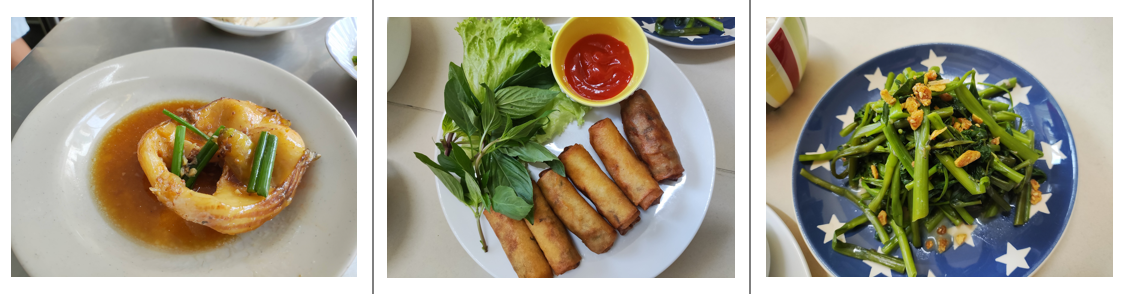
Boiled river fish (left), fried spring rolls (center), stir-fried water spinach with garlic (right)
As dual-income households increase to cover children's education expenses, it's common to see time-rich mothers-in-law living in multi-generational homes taking charge of cooking. Home-cooked meals are limited to about one or two times a day, while street food stalls, abundant throughout the city, are utilized at any hour to flexibly accommodate lifestyles, often relying on eating out.
For ingredient procurement, they skillfully utilize both markets stocked with fresh goods from early morning and supermarkets convenient for after-work shopping.
Post-meal cleanup is often handled by women. Since typical Vietnamese households lack water heaters, dishes are washed together in a large basin filled with water and detergent.
For more details on the real-life local circumstances not covered in this article, such as the convenient “wavy-edge knife” commonly used for decorative cutting in Vietnamese homes, check out our detailed coverage here.
▶Related articles:[Global series: Cuisine and Housework] Vietnam: What to Do When Cooking
3. Cambodia: Family Gatherings and Supporting Local Markets
In Cambodia, meals are so important that “Have you eaten yet?” serves as a greeting. Due to a social culture without overtime work, it's a daily routine for the entire family to gather around large shared dishes by 7 PM. Each person places side dishes onto their plate of white rice to eat.
The food eaten at home is local cuisine known as “Khmer cuisine.” The seasoning is surprisingly salty for Japanese palates, though it uses less chili pepper heat compared to Thai food. Other representative dishes include sour soups like “som rom chuay kruang,” where the flavor hinges on “kruang” – a paste made from herbs. The mortar used to make kruang is an indispensable cooking tool in Cambodian households.
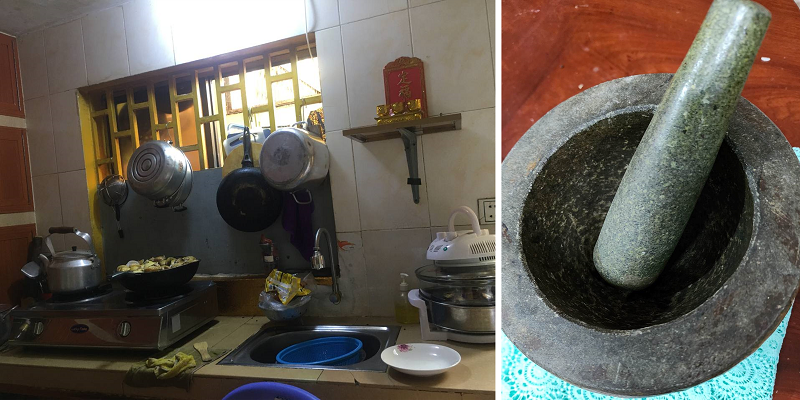
Kitchen and mortar
Many dual-income families with young children rely on mothers living at home to handle cooking. Breakfast is often eaten at street stalls, while ingredients for lunch and dinner are sourced fresh daily from local markets within their living area, rather than relying on refrigerated storage.
After meals, cleanup isn't solely left to the mother; available family members like the father or children pitch in. Also, since water heaters are uncommon, dishes are typically washed by hand with water and detergent.
For more detailed insights into local kitchen practices, including those in traditional Cambodian stilt houses and urban shop houses, check out this article.
▶Related articles:[Global series: Cuisine and Housework] Cambodia: What to do when cooking
4. Thailand Edition: Shared Platters at the Table and Thai Men Who Cook Well
At Thai dining tables, each person serves rice onto their own flat plate and then adds their favorite side dishes from the large communal platter in the center to eat together. Eating with hands is uncommon; instead, spoons and forks are used to skillfully remove fish bones and shrimp tails before eating. Many dishes, like “Ga Pao Rice” and “Tom Yum Goong,” feature spicy seasoning, with chili peppers used to adjust the heat level. Children gradually become accustomed to spicy flavors starting around elementary school age, reaching the level of extreme spiciness by adulthood. Additionally, dishes like “Kai Pao” (Thai-style braised pork belly), flavored with a paste made from crushed cilantro roots, garlic, and white pepper, are also popular.
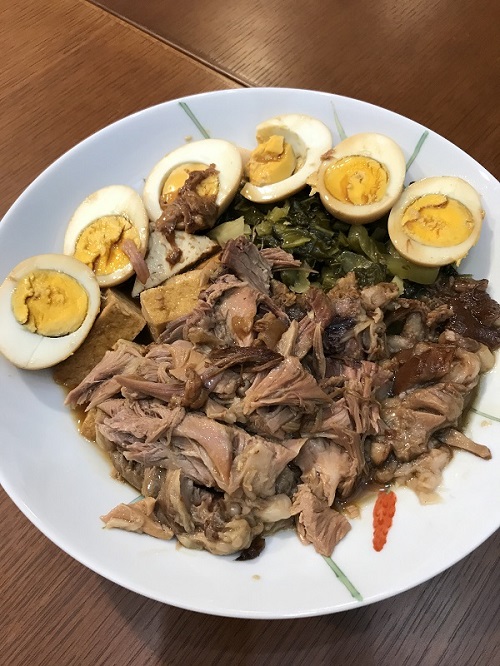
“Kai Paro” Pork Knuckle Version
What's interesting is how often Thai men cook. Compared to other Asian countries, married Thai men cook more frequently, actively preparing breakfast and cooking dinner at home 3-4 times a week (using street stalls or cafeterias on the remaining days). To easily make fried foods at home without the hassle of cleaning up oil splatters, more households are enjoying dishes like “Moo Groop”—crispy fried pork belly chunks made using an air fryer.
Additionally, dishwashing after meals is naturally divided between spouses, with the one who is free taking charge.
This article details the real kitchen dynamics in Thailand, including Thai women's particular preferences for using markets versus supermarkets and how men become engrossed in elaborate cooking on their days off.
▶Related articles:[Global series: Cuisine and Housework] Thailand: What to do when cooking
5. Philippines Edition: A Festive Table to Enjoy with Everyone
Filipinos have a communication-focused culture where they enjoy eating meals together, whether at home or at work. They love eating so much that in addition to three meals a day, they have morning and afternoon snack times called “merienda.”
Meals typically consist of white rice with meat or fish. To make the fluffy white rice more delicious, they pour sinigang soup (without ingredients) over it to make it moist. There is also a perception that “vegetables are food for the poor,” so vegetables are not highly valued in meals. The eating style involves holding a spoon in the right hand and a fork in the left, cutting meat or vegetables alongside the spoon and mixing them together to eat—a two-in-one approach.
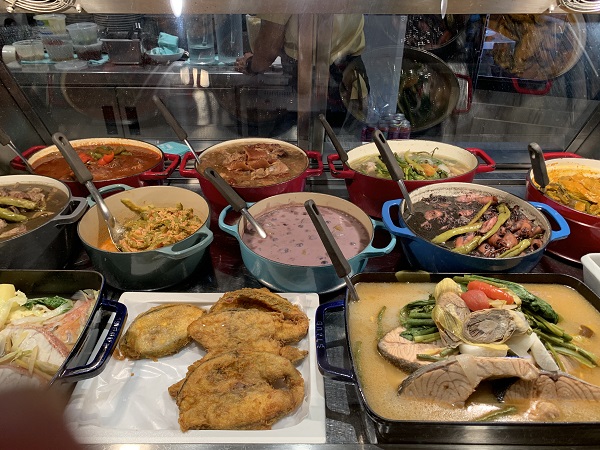
Delicatessen: Mostly fried foods and soups. The dish on the right front is salmon shinigan soup.
Middle-class households typically stock up on groceries twice a month during payday, buying in bulk at supermarkets. They stockpile not only fresh produce but also non-perishable items like canned goods. In dual-income middle-class households, it's common to hire a maid, who usually handles the cooking. Furthermore, Philippine homes often feature a “dirty kitchen” for food preparation, located outdoors or in the maid's quarters, in addition to the main kitchen used by the family.
This article details the vibrant atmosphere at supermarkets on payday and the culture of “merienda,” the twice-daily snack time, offering a deeper look into how Filipinos enjoy their food.
6. India Edition: Family Mealtime Scenes and Attitudes Toward Rice
India is diverse in religion and ethnicity, and its food culture also varies greatly by household. What people eat changes depending on religion—Hinduism, Islam, Jainism—and whether the region centers on rice also differs.
In North India, it is believed that “rice cools the body, makes you fat, and is hard to digest,” so people tend to avoid rice at night. When cooking rice, they use a method where it is boiled in plenty of water, then the water is discarded.
Additionally, fresh ingredients are highly valued, so many households purchase only what they need daily from night bazaars or rickshaw vendors. They generally dislike preparing meals in advance, preferring to cook everything fresh each time.
In urban nuclear families, meals are shared at the dining table. However, since the staple “chapati” is served fresh, one at a time, it is customary for the mother, who prepares the food, to eat last.
Dishes like lentil or vegetable curries, salads, and achar use generous amounts of spices. Specialized cookware like pressure cookers (cookers) and iron pots (kurai) are used for cooking, while sturdy, clean stainless steel tableware is standard.
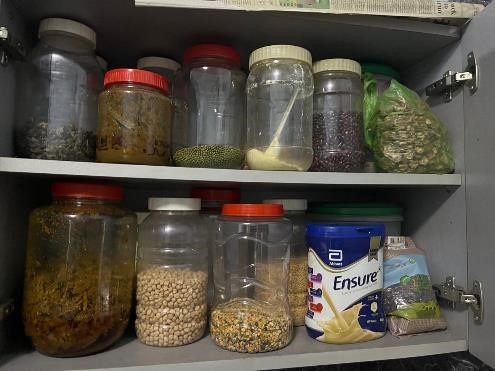
A variety of beans and achar
While the tradition of eating with hands persists, an increasing number of young people prefer spoons and forks. Furthermore, many households in the middle class and above employ maids specialized in cooking.
This article delves into the background of India's diverse food culture, including the rise of “egg-tarians” who consume eggs and the use of different utensils for religious ceremonies.
▶Related articles:[Global series: Cuisine and Housework] India: What to do when cooking
7. Indonesia Edition: Flexible Meal Times and Evolving Eating Habits
In Indonesia, the custom of eating together at set times is less common; it's more typical for people to eat whenever they like. While the portions for the three main meals are small, Indonesians prefer snacks, so they are constantly eating or drinking something. Usually, a large amount of food is prepared early in the morning and laid out on the table, with family members eating whenever it suits them.
A typical meal consists of a single plate with rice topped with fish, meat, or stir-fried dishes, often accompanied by soup. Another distinctive cooking tool is the stone mortar and pestle, known as the “Cobek.” This Cobek is used to blend spices, creating homemade “Sambal” to accompany dishes and enjoy unique flavors. Eating styles have also evolved: from the traditional practice of eating only with the right hand, people now use cutlery, such as a spoon (right hand) and fork (left hand), and even chopsticks for noodles.
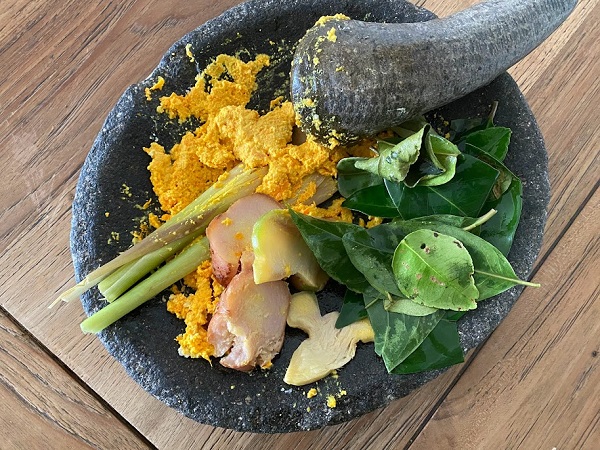
Grind spices using a stone mortar called a cobek to blend them.
Additionally, grocery shopping habits are diversifying. While some people frequently buy 1-3 days' worth of fresh produce at local markets, others increasingly opt to buy 1-2 weeks' worth in bulk at supermarkets or through online services offering free shipping. After-meal cleanup is often handled by domestic helpers in households with them, or by mothers in households without.
For more detailed information, including the prevalence of online supermarkets and delivery apps in Indonesia, and the situation regarding dedicated kitchen areas for domestic helpers in luxury condominiums, please refer to this article.
8. Shanghai, China: Side Dishes Take Center Stage and a Commitment to Fresh Ingredients
In Shanghai, China, home cooking is often the “dad's cooking” made by fathers rather than mothers, with fathers honing their skills to cater to the family's tastes. The dining table centers around side dishes; plain rice is rarely served unless requested. The style is to fill up on the abundant side dishes first, then eat rice if still hungry.
Seasoning relies on simple ingredients like soy sauce, black vinegar, sugar, garlic, ginger, and green onions to create deep flavors. Common Chinese spices (like star anise or chili peppers) are used sparingly, with Shanghai cuisine centered around rich, sweet dishes like “red-braised pork.” Recently, alongside traditional dishes, pasta and steak have also made their way onto the table.
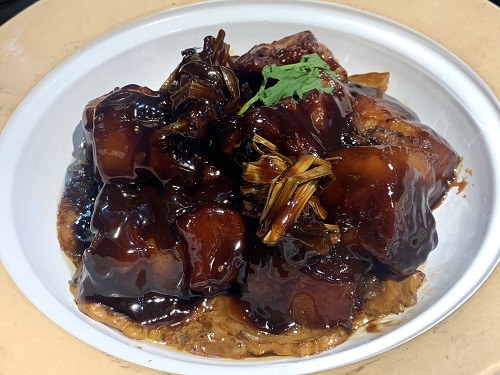
Red-Braised Pork, a signature dish of Shanghai cuisine. Rich and sweet.
Additionally, many households strictly avoid preparing meals in advance, instead cooking fresh ingredients purchased that day on the same day. For ingredient procurement, they combine markets and supermarkets with convenient delivery services like “Hema Fresh.” Mealtimes aren't necessarily when the whole family gathers together; it's a free-form style where people eat when they want to eat. However, it remains a warm space for communication, which is one of its defining features. Furthermore, cleanup is often handled by the father.
For a detailed look at Shanghai kitchens—including the layout considerations of kitchens positioned near the entrance and the use of cooking tools like wok pans and square knives—check out this article.
9. Saudi Arabia: Bulk Shopping at the Supermarket and Family Gatherings for Dinner
In Saudi Arabia, large families spanning two or three generations are common. For food procurement, the mainstream practice is to make bulk purchases of long-lasting items like pasta and eggs several times a month at large supermarkets.
The daily meal rhythm is clearly divided. Breakfast is often a quick affair with bread or bean dishes. Lunch is frequently eaten individually since the family isn't always together. However, dinner is the centerpiece of home cooking and a time when the entire family gathers. Generous, large-plate dishes, rich with spices and oil, are handmade. A staple home dish is “kapsa,” a rice dish cooked with meat and spices.
Furthermore, sharing dishes from large platters is fundamental to home cooking, reflecting a deeply rooted culture that values family and kinship bonds, as well as hospitality. People deepen their connections by sharing food from the platters using their hands or spoons. Particularly on Fridays, following Islamic custom, relatives gather, making it a virtue to prepare extra food. Post-meal cleanup tends to be handled collaboratively by female family members or by a housekeeper, though dishwasher use is increasing recently.
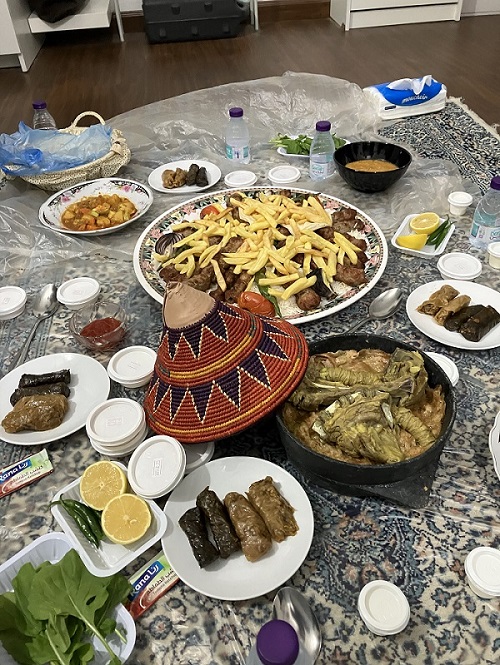
The dining table of a tribal family from Najran in the southern region, now living in the city.
Local cuisine (Laksh) and barbecue dishes ordered for delivery
(examples of large platters other than Kapsah).
(Many people from rural areas live in urban centers. Saudis place great importance on their origins.)
This article details Saudi Arabia's unique living conditions, including spacious kitchen facilities for large families, powerful exhaust fans, and gas cylinder arrangements.
10. [Summary] Three Trends Emerging from Eight Countries
Looking at the home cooking situations in the eight countries introduced so far, we see not only superficial menu differences between countries but also several common trends based on local lifestyles and values. Here, we summarize three key insights to consider in global marketing.
(1) Targeting based on shopping frequency and storage habits (“Daily Freshness Group” vs. “Bulk Buy & Stockpile Group”)
Grocery shopping behavior broadly divides into two groups. The “Daily Freshness Group,” seen in Cambodia, India, Shanghai, China, and parts of Vietnam, tends to procure fresh ingredients needed that day via markets or delivery, regardless of refrigerator availability, and dislikes preparing meals in advance. In these areas, establishing daily touchpoints, offering small-portion packaging, and emphasizing freshness in marketing appeals are effective. Conversely, the “Bulk Buyers/Stockpiling Group,” seen in Saudi Arabia, the Philippines, and parts of Indonesia, consists of large families, those influenced by payday habits, and the proliferation of online supermarkets. They tend to purchase large quantities, focusing on items like canned goods and pasta that can be stored at room temperature. Large-capacity packaging, products with excellent shelf life, and promotions offering savings for bulk purchases are well-suited to this group.
(2) The Changing “Kitchen Leader” and Cooking Approaches (The Presence of Men, Seniors, and Domestic Helpers)
The stereotype that “cooking is the mother's job” does not hold globally. In Thailand, men cook frequently, and in Shanghai, “Dad's cooking” is a staple, with men often being the primary cooks. Additionally, in middle-class and higher households, maids often handle cooking and cleanup. Countries like the Philippines even have dedicated prep areas for maids called “dirty kitchens.” In Vietnam and Cambodia, it's common for mothers-in-law living in the same household to take on these roles. Given these dynamics, when promoting cooking appliances or food products, it's crucial to clearly identify who will actually be using them (maids, men, or seniors).
(3) Forms of Shared Meals and Mealtime Management (“Absolute Gathering” vs. “Individual Meals/Flexible Timing”)
The nature of mealtime communication also varies significantly by country. In “absolute gathering/shared platter” cultures, like Cambodia's 7 PM or Saudi Arabia's dinner, where families gather at a fixed time, party-sized portions and foods with shareable shapes are preferred. Conversely, countries like Indonesia or Shanghai, China, follow an “individual eating/flexible timing” model where prepared dishes are placed on the table, and people eat what they want when they want. In these cases, single-serving portions (individual packaging), heat retention capabilities, and ease of reheating in a microwave become key product values.
Thus, the key to successful overseas expansion lies not only in localizing each country's “taste preferences” but also in understanding the differences in the process of “who buys, prepares, and eats; when; and how.”